How do strategic PMOs bridge the gap between organizational strategy and project execution?
According to the research study Strategic PMO Implementation for Organizational Excellence, PMOs must adapt over time to ensure that they are relevant and deliver value. No longer simply an administrative and compliance office, the strategic PMO influences and guides the organization—not the reverse. It establishes alignment between portfolios, programs, and projects and organizational goals. And it is pivotal to the holistic company’s success.
But how does it achieve this? By elevating its own role.
Discover how strategic PMOs align with executives, prioritize high-value initiatives, and measure value realization across the portfolio. Plus, learn best practices and frameworks powered by Prism PPM.
What Makes a PMO Truly Strategic?
First, let’s consider what a strategic PMO is. This type of PMO creates value for the holistic organization. It prioritizes effectively and optimizes project pipelines and performance. It ensures alignment with organizational goals. And it defines standards for the company, accounting for the entirety of its projects and portfolios.
Let’s take a closer look at the strategic PMO.
Tactical PMO vs. Strategic PMO
Today’s PMO differentiates itself from the PMO of yesterday in several key ways. Most importantly, it is not purely a tactical PMO.
While the tactical PMO focuses on day-to-day operations, the strategic PMO takes into account the holistic organization, looking at the enterprise at a high level. Tactical PMOs are more focused on the short-term, enforcing standards and compliance in everyday activities. Strategic PMOs, on the other hand, create the standards, looking at the big picture and determining how the organization can innovate at scale.
| Strategic | Tactical | |
| Objectives/Goals | Supporting overarching business goals | Compliance |
| Timeline | Long-term | Short-term |
| Scope | Broad | Narrow |
| Organizational Role | Leadership | Administrative/Supportive |
| Focus | Process and Results | Results |
| Results | Ensuring the company is undertaking the right projects at the right time, facilitating alignment between discrete projects and company goals | Ensuring discrete projects are completed correctly, on-time, and within budget |
Why organizations are shifting to strategic governance
PMOs must be modern units today. There is greater competition, and environments are rapidly changing. It’s essential to align every initiative with your broader goals. Doing so facilitates greater transparency and enhances long-term vision and viability. This means a broader focus—and a more significant one.
Strategic governance ensures cohesion and greater interdepartmental unity. It also means a focus on greater value delivery. This PMO is more flexible and adaptable than the “compliance enforcer” of the past. It examines the organization as a whole, not as separate departments or units. And it looks at how you can achieve your overarching goals—by prioritizing the right projects.
The role of data-driven decisions
The strategic PMO doesn’t rely on gut instincts. It must make informed decisions, and informed decisions are data-backed.
Mining data usually requires robust technology that provides comprehensive analytics like Prism PPM. It allows you to examine performance for individual projects, too. Using data, you can better understand your project and portfolio ROI, resource utilization, and other metrics to evaluate previous performance and anticipate future needs. You can also use this information to predict preventable problems and deal with challenges. This allows you to prepare and manage risks more effectively.
For example, you can use data about past projects to determine the resources needed for future projects. You can also use this information to assess timelines and ensure that you are utilizing your time (and people) to your advantage.
Building Executive Alignment
Executive alignment in PMO strategy is critical for attaining buy-in. The PMO bridges strategy and project management and must ensure understanding on both sides.
Understanding executive priorities and KPIs
How can PMOs build stronger executive alignment around strategy, portfolio priorities, and capacity?
PMO strategy alignment involves establishing KPIs to ensure that you know what you are trying to achieve and have a system for measuring outcomes. From the beginning, identify the most important KPIs for overall portfolio success, as well as metrics for each project. Examples might include resource utilization rate and ROI.
Bear in mind that KPIs should align with executive priorities, so you will need to work with leadership to understand their most pressing needs.
In some cases, executives will have priorities that don’t necessarily align with the priorities of the organization. Your job is to educate and explain why certain initiatives take precedence over others—in other words, making it clear why some projects are more important than others at a given time for the health of the entire company. It’s not an easy task, but it’s an essential one for clarifying goals and shaping the organization’s direction.
Translating strategy into actionable portfolio plans
How does this translate into action? Through clearly defined and articulated portfolio plans. It’s about connecting the “why” with the “how.”
This starts with choosing a project management methodology, such as agile, waterfall, or hybrid, to guide your approach. Driving action also requires breaking down portfolios into smaller components. This makes complex projects more approachable. It’s also more feasible to connect specific actions to larger plans and goals.
It’s helpful to use the SMART framework (Specific, Measurable, Actionable, Relevant, and Time-bound) to ensure that your smaller objectives and benchmarks are realistic and achievable. In any case, standardize your processes across the organization to reduce instances of miscommunication and misalignment.
That doesn’t mean you always have to apply exactly the same methodologies to every project—for example, as part of a hybrid approach, many organizations use waterfall for some components and agile for others—but it does mean your rationale and overall strategy must be consistent. For instance, you should apply the same project prioritization framework to every initiative, and that should be apparent to every team member and stakeholder.
Communicating capacity, constraints, and trade-offs
Of course, there are challenges when you’re working to attain strategic alignment and buy-in. But you won’t achieve your goals without these key elements.
When articulating concepts like capacity, constraints, and trade-offs, use ample data from your PPM platform or other tools to show the clear business case for your decisions. This helps you justify requests for resources and explain competing priorities and demands.
You should also use this information to communicate benefits that outweigh risks, particularly when projects conflict or demand the same resources. It’s important to clarify how your prioritization framework and process works to avoid confusion.
How Prism PPM supports strategy mapping & alignment
How does a PPM platform like Prism PPM support alignment, prioritization scoring, scenario planning, and performance tracking?
The solution offers strategy mapping and portfolio roadmaps that allow you to better conceptualize and account for the entirety of your organization’s initiatives and ensure alignment with your overarching strategy. You’ll also get comprehensive reporting and dashboards that give you visibility into progress and results, fueling more effective decision-making.
Prioritizing the Right Work
How do you choose and prioritize the right projects? The strategic PMO utilizes consistent project prioritization models to ensure you’re completing the right projects at the right time.
Why prioritization often fails (and how to fix it)
One of the main costs of poor (or nonexistent) strategic alignment is ineffective prioritization. This may result from a lack of concrete or clear organizational goals, a failure to link objectives to various initiatives, poor stakeholder engagement, or an inability to account for competing priorities, among other reasons.
Prioritization requires a proactive, rather than reactive, approach. That starts with going to the top: collaborating with stakeholders to align on key objectives and solidify a cohesive portfolio project management strategy.
Collaboration doesn’t stop there. You also need to inform and engage stakeholders throughout your initiatives, sharing real-time data, checking in regularly, and ensuring constant communication.
Criteria for high-value prioritization (value, risk, cost, urgency)
Establish a PMO prioritization framework for assessing all project requests. This leads to greater value delivery for individual projects and the entire organization.
The main criteria for prioritization are:
- Value
- Risk
- Cost
- Urgency
Within each factor, you should have a set of criteria for evaluation. Assign each factor a weight to come up with an overall score that will allow you to determine the project’s overall priority in the grander scheme of things. Make everyone involved aware of these criteria so there are no surprises when they propose projects.
Using Prism PPM for prioritization scoring & scenario planning
To prioritize effectively, you need a system for weighting requests and planning. Prism PPM’s comprehensive platform allows you to map your holistic project lifecycle, planning for various scenarios. You can capture project requests via a centralized intake tool and prioritize the right projects by using your own weighted criteria with the platform’s Business Value Assessment tool.
Delivering and Measuring Value Realization
Value means little without a means of evaluating it. So, how do you measure and communicate value?
Defining value (strategic, financial, operational)
Portfolio value realization starts with a clear definition of what value is. And that begins with solidified goals.
We’ve underscored the need for clearly established objectives for the organization. These will guide your definition of value.
Consider the key elements: strategy, finance, and operations. Strategic alignment means determining how projects correspond to goals to deliver value. This can’t be vague. For example, when defining value in operational terms, describe how much you want to improve the rate of efficiency with numerical figures, such as cutting specific amounts of time spent on specific tasks.
Tracking progress against strategic KPIs
Now, how do you actually measure the value delivered? The answer: KPIs.
KPIs give you a means of making data-backed decisions, ensuring stakeholder alignment, and tracking progress—as well as evaluating overall business performance.
Consider examples like resource utilization, on-time project completion, benefits realization, and time to market. Create strategic KPIs to have metrics to evaluate success and pinpoint areas of improvement. These metrics also give you concrete tools to present your business case to stakeholders and justify your rationale for proceeding.
Communicating value to leadership
That brings us to our next subject: communicating portfolio value realization to leadership.
At times, it may feel like the PMO and leadership are on different pages. If that’s the case, then you’re setting yourself up for failure and misunderstandings.
Communication is key to ensuring alignment. Essentially, you need to prove to leadership how your activities and processes benefit them—that is, the overall company. Show them why you’re doing what you’re doing and why they should be invested in your efforts.
The key elements of your business case are:
- Data
- KPIs
- Transparency
Give stakeholders a clear picture of what you’re doing, why you’re doing it, and how you can do it.
How Prism PPM visualizes KPIs, results & impact
You can’t be a fully strategic PMO without the right tools. For visualizing KPIs, results, and impact. You need a platform built for project portfolio management.
From ideation to reporting, Prism PPM allows you to plan, assess results, and measure impact. Features like resource management and scenario planning, customizable templates outlining milestones and deadlines, and program management modules allow you to map out your project and objectives. Meanwhile, out-of-the-box dashboards and multiple reporting options allow you to track and manage results, giving you full visibility into your efforts and successes.
Becoming a Truly Strategic PMO
The strategic PMO evolves. It continues to assess and reassess its functions and processes to deliver long-term value.
Embedding continuous alignment cycles
The work for PMOs never ends. You must continuously refine and adjust your approach to ensure consistent strategic alignment.
Continuous alignment cycles involve ensuring that your goals are always at the forefront of your plans and that you are constantly using them to guide prioritization and processes.
Remember that your overarching organizational objectives must guide every project and initiative. You should have a clear prioritization and selection framework based on these goals. That allows you to assess each idea as objectively as possible.
There should also be a plan in place for delivering and receiving feedback, as well as for measuring outcomes and adapting based on successes and failures. Leveraging PPM software helps you track and manage alignment cycles, enabling you to track and evaluate progress.
Maintaining governance without slowing delivery
The PMO is more than just an enabler. It sets the standards for the rest of the organization. In doing so, it ensures proper governance.
To achieve proper alignment and decision-making capabilities, you must maintain strong governance without slowing down project completion and value delivery. Establish a framework that empowers team members to complete their responsibilities without the need for hand-holding.
While the PMO must maintain authority, by creating easy-to-follow guidelines, team members are more capable of making decisions independently but with clear guidance.
Automation is key as well. Using a platform like Prism PPM allows you to speed up processes like tracking KPIs and project progress efficiently and without human intervention.
Most of all, be a purveyor of information. Establish frameworks and templates for everything, such as ensuring projects meet necessary criteria.
Using data to guide decisions at every level
The modern PMO must be data-driven.
Data doesn’t just help provide direction for individual initiatives; it shapes the direction of the PMO and entire organization. That means utilizing data at every level, from top to bottom.
Integrate digital tools wherever possible, because this is how you collect data and empower the company to use that information effectively. This is also how you achieve digital transformation—essential for becoming more efficient and making more effective and powerful decisions that shape the enterprise.
Remember: No one should be making decisions that are not supported by facts.
How Prism PPM Helps PMOs Operate Strategically
By now, it’s probably obvious that PMOs need technology to deliver value and have meaningful strategic impact. But not all software solutions can help you in the way you need.
Prism PPM is a project portfolio management system equipped with capabilities that help you manage every phase and level of every project, program, and portfolio. It’s a tool that gives PMOs the visibility, governance, and analytics needed to operate strategically.
With robust features, Prism PPM helps every PMO achieve greater value realization:
- Idea & Demand Management
- Project Planning
- Portfolio and Program Management
- Resource Management
- Agile Project Management Enabled
- Time Tracking and Budgeting
- Reporting & Analytics
- Strong Security Features
The customizable platform offers all these capabilities and more, ensuring value-driven portfolio management and prioritization.
Final Thoughts
The strategic PMO is not static. It’s evolving. That requires it to be agile and nimble, adapting to changing landscapes and directions. Those that are able to be flexible and embrace this mentality will deliver greater value.
The path to strategic maturity
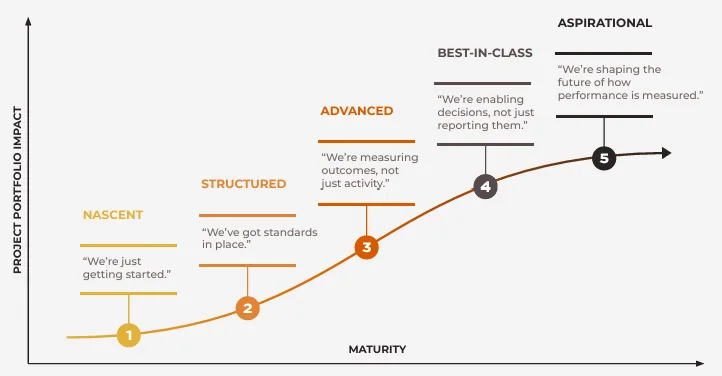
PMOs must mature like any other entity. The path to growing and evolving into a value enabler involves meeting the needs of the holistic organization while being dynamic and value-focused. To become a mature PMO, you must shift your mindset from transactional to strategic.
The PMO’s role in enabling portfolio-level impact
Ultimately, the PMO’s role is to impact the organization holistically—that is, at portfolio level, not merely at a project level. In this way, it becomes a partner to the organization, a key decision-maker, and a deliverer of concrete value.
Prism PPM helps you achieve strategic alignment at every level. Book a 30-minute consult or a 60-minute demo today to learn how.