
A company is updating its IT infrastructure. How is the project progressing? Is it on schedule? Are the costs as anticipated? What if it’s ahead of schedule but over budget? What if it’s under budget but still behind schedule? Each of these scenarios presents a problem.
This is where earned value management (EVM) enters the picture.
An objective, quantitative means of measuring project performance, EVM is used across industries, such as IT, Construction, Aerospace, Government, Biotech, and many others. Earned value management integrates cost, schedule and scope and allows you to identify problems and common PPM challenges early.
Find out exactly how your project portfolios are doing, get an unbiased look at your projects’ health, make data-backed decisions, ensure greater transparency, better forecast potential problems, and discover how your projects are actually producing. These are just some of the benefits you’ll get when you apply EVM to your projects.
What Is Earned Value Management?
While qualitative measures can be helpful, quantitative approaches give you unbiased assessments and clear metrics to evaluate your efforts. Earned value management, or budgeted cost of work performed (BCWP), is an objective way to calculate the health of a project at any point in time.
A system for project governance, this project management methodology measures projects’ performance according to three baselines: scope, schedule, and cost. That way, you can assess whether the project is on track financially. Essentially, you are comparing your budget, schedule, and planned performance against how the project is actually delivering.
Using EVM, you will see how your investments are paying off. You will know whether a project is behind, ahead, over budget, under budget, or right on track.
Let’s say you have a project with a budget of $50,000. You expect it to take five months to complete. If the project follows a linear, straightforward timeline, you should expect that one month in, you will have spent $10,000 and completed 20% of your budget. But projects are rarely (if ever) this simple in the real world. By applying EVM, you can gain an accurate picture of expected results against actual results and achievements. You will better understand the real value you’re creating and whether it tracks against expected outcomes.
Earned Value Management Formulas
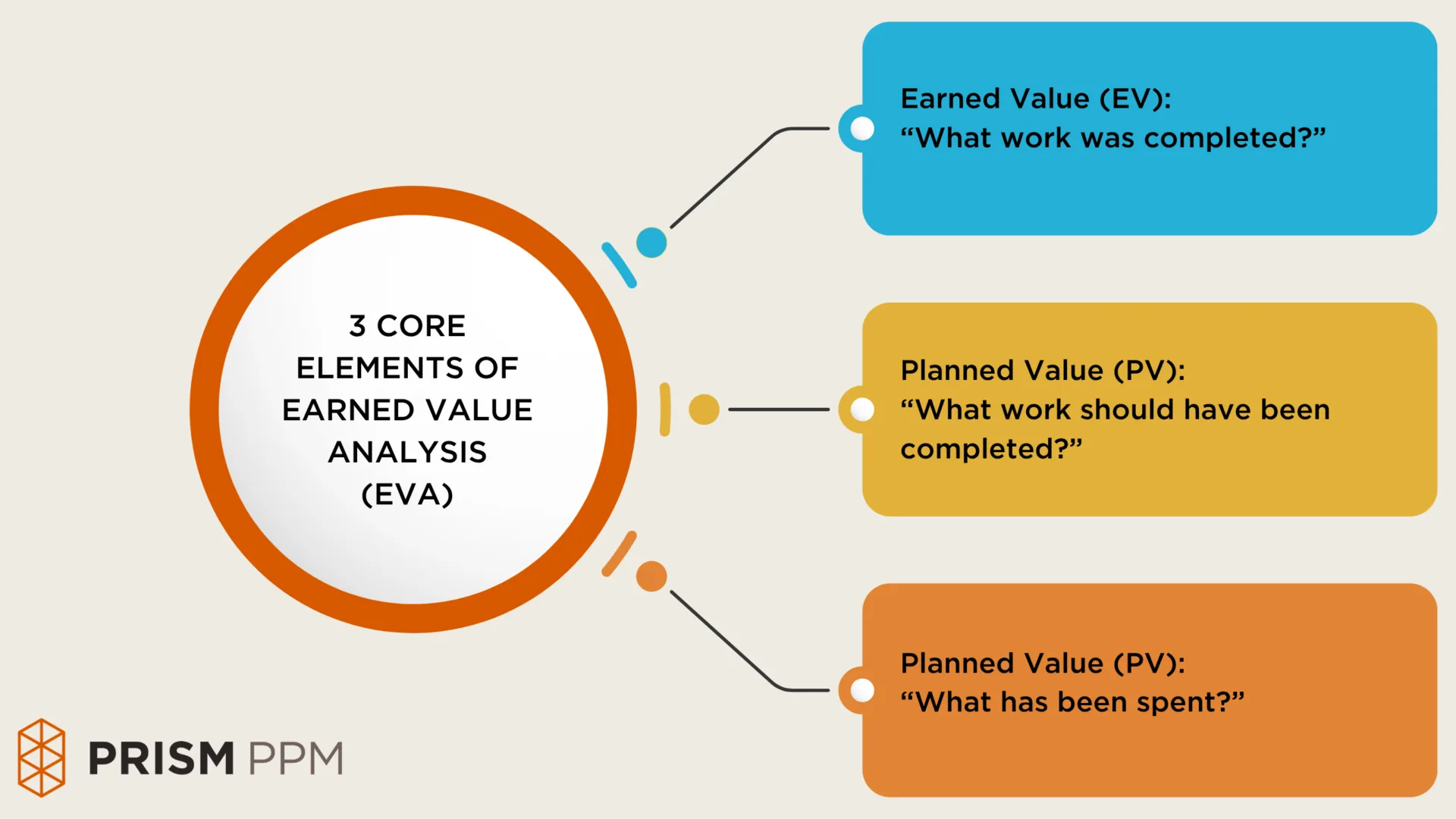
Before we get into the most important earned value formulas, we should establish some key terms:
- Earned Value (EV): Percentage and value of planned work completed compared to your budget
- Planned Value (PV): Budgeted cost of the project
- Actual Cost (AC): Total actual cost to complete the work
- Estimate at Completion (EAC): A projection of the total costs
- Budget at Completion (BAC): Total budget
The most important formula to know is EV = PV*(% of project completed). This represents the amount of value your project has produced at a given point in time.
Other formulas to consider include:
- Cost Performance Index (CPI) = EV/AC
- Schedule Performance Index (SPI) = EV/PV
- Cost Variance (CV) = EV-AC
- EAC = BAC/CPI
- Estimate to Complete (ETC) = BAC – EV/CPI
6 Benefits of Earned Value Management
1. Early Issue Detection
Keep projects on track by catching issues early. Leveraging earned value management formulas and techniques allows you to spot cost and timeline problems and discrepancies before they wreak havoc on your project. You’ll get early warnings before they have a negative impact.
2. Enhanced Forecasting
Improve your forecasting accuracy by gaining insights into project and performance trends. Through EVM, you’ll get early information about how you can expect your projects to perform, based on real, accurate, predictive data.
3. Risk Reduction
EVM gives you greater control over your schedule and costs. That lowers the risk of budget overruns, delays, and other issues that often interfere with a project’s success. You will know exactly how much value you’re getting for the resources you’re expending.
4. Better Decision-Making
EVM provides insights into an array of metrics, enabling you to make data-backed decisions. With a more accurate picture of your project scope, resources, and other information, you are primed to be proactive instead of reactive. That enhances your decision-making capabilities overall.
5. Improved Cost Control
Stay within budget and control cost variations. EVM is a structured assessment tool that allows you to anticipate budgetary concerns proactively. This enables you to distribute resources and lower costs, as you continuously track costs. It also encourages you to optimize budgets, showing you performance, resource expenditures, and trends.
6. Objective Project Assessment
Earned value management is an objective tool for measuring a project’s deliverables, not just in terms of the actual results, but also in terms of the value you’ve derived. EVM offers an objective, data-backed assessment of how successfully you have completed a project. That promotes accountability and responsibility and replaces subjective performance evaluations.
How to Integrate Earned Value Analysis in Project Management Frameworks
Establish a Weighted Progress Foundation.
The weighted progress foundation or contribution allows you to determine how much a specific task contributes to the entirety of the project or portfolio.
A particular task weight is determined by the formula: task weight = (task budget or time) / (total budget or time allotted).
It’s necessary to establish this foundation to ensure individual tasks are weighted according to their importance in the overall project or portfolio.
Define your baseline.
You should define your performance measurement baseline before even initiating the project. This is a time-phased budget against which you can measure and track EV. It establishes the PV at various points within your project timeline.
Calculate EV at each review cycle.
Using task weights and the total budgeted cost for the project, calculate EV at every portfolio review cycle. This allows you to evaluate the monetary value of the works you have completed already, at any given point. You will be better equipped to understand what you’ve achieved so far and spot issues before they escalate.
Integrate EVM into your preferred project management methodology.
EVM is flexible. You can scale and adjust this metric based on your preferred PM approach, whether that’s waterfall, agile, or hybrid. For example, in agile, you would measure different iterations, using story points, establishing a PV for each iteration’s scope. Then, you would calculate EV according to the story points of each feature or project installment after every sprint.
When to Use an Earned Value Management System
While EVM is a useful metric, it isn’t always the best approach for every scenario. For example, if you’re dealing with constantly changing project scopes, poorly defined budgets, short timelines, strictly creative or exploratory work, or small-scale or simple projects, it is often better to opt for a different methodology.
However, it can be highly valuable in other scenarios. Some instances where it can be very helpful to use an EVM system are:
- Your project demands extensive budget control.
- You have large project portfolios or are managing multiple projects at once.
- The projects are complex in terms of budgets and/or schedules (e.g. strict timelines, condensed budgets, etc.).
- The projects themselves are highly complex.
- Your projects have clearly defined deliverables.
- Your project requires extensive forecasting.
- You will need to answer to stakeholders throughout the project; EVM is helpful for reporting.
Conclusion: Applying Earned Value Management in the Real World
Replace subject project portfolio management with objective, data-backed analysis. Earned value management uncovers true project performance and how much value you’re actually creating with your project portfolios. But how do you apply it in the real world without spending too much time on painstaking calculations?
You need the right software on your side.
Prism PPM automatically calculates essential metrics like EVM and surfaces real-time data to allow you to observe and understand project performance. Get early warning signs for budget overruns and deadline issues. View EVM data across all the projects in your portfolio. Save time and money, gain real-time visibility, and ensure that your projects are delivering demonstrable value. Stay current without putting in extensive manual labor.
Want to learn more about how Prism PPM automates earned value management assessment? Discover all that and more. Book a demo today.