
TL;DR: The agile PMO reconceptualizes the project management office as a flexible, collaborative partner in ensuring that projects align with larger organizational goals. This new PMO represents a departure from the traditional PMO, which focuses on project compliance and procedures. While agile isn’t perfect, it tends to lead to a better process and outcomes.
A study of more than 1,250 IT projects found that those using agile approaches achieved a 21% higher success rate than traditional methodologies. Yet the debate over the agile PMO vs traditional PMO rages on.
While organizations have several choices of what type of project management office to use, the PMO and agile go hand in hand. But what, exactly, does the agile project management office look like? How does it differ from a traditional PMO? When should you use each approach?
Find out why organizations are increasingly adopting an agile PMO structure and how it will benefit you.
What Is a Traditional PMO?
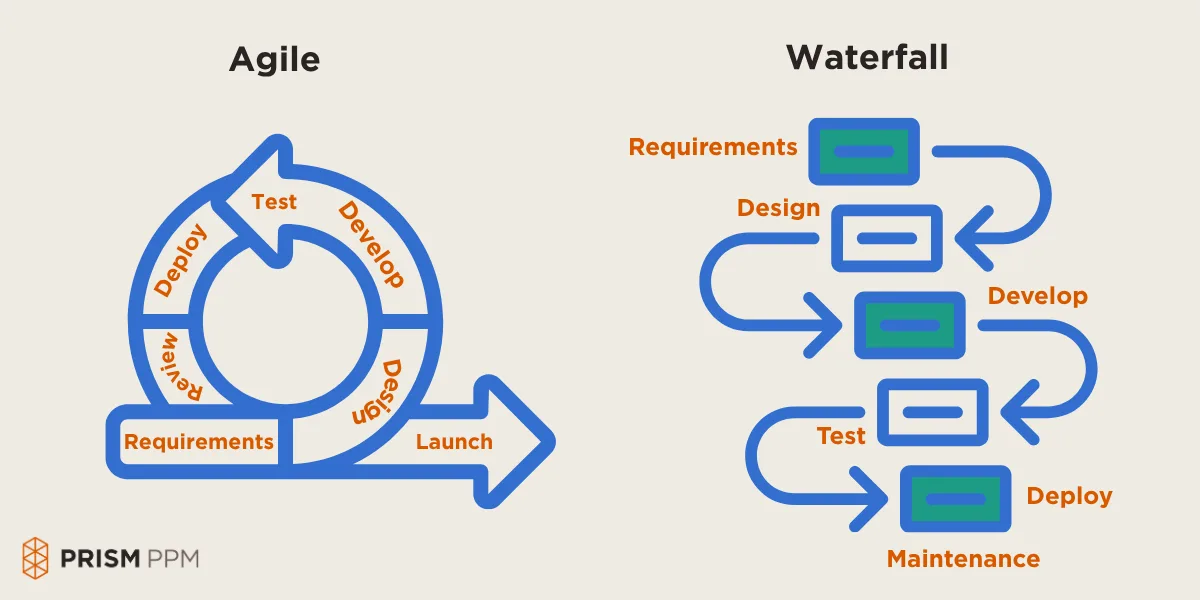
The traditional PMO focuses on standardizing project management processes within the company in order to ensure consistency, minimize risk, align with stakeholder expectations, and meet “iron triangle” specifications—on time, within budget, and within scope. Waterfall is the main traditional project management approach.
With well-defined procedures, the PMO is equipped to monitor all activities and keep projects following a rigid path.
What Is an Agile PMO?
The agile PMO, in contrast, is a flexible, adaptable, collaborative, and iterative style. Instead of the rigid waterfall approach, agile continuously responds to changes that naturally occur over the course of a project. And instead of procedures, this methodology focuses on people and collaboration.
Modern PMOs embrace this newer approach to better respond to evolving requirements more efficiently and involve the client or customer and team in decision-making.
Agile PMO vs Traditional PMO
| Traditional PMO | Agile PMO | |
| Definition | A centralized project management office that ensures project standards and compliance, establishes procedures and best practices, and documents and governs all projects. | A flexible project management office that focuses on delivering value and continuous improvement, acting as a mentor and bridge between other teams. |
| Focus | • Following sequential processes• Linear project progression• Extensive planning | • Delivering value• Flexibility• Adaptability• Collaboration• Iteration |
| Process | • Planning happens before the project launches• The timeline, scope, budget, and other details are established upfront• Each phase of the project must be completed before the next one begins | • Planning takes place iteratively• The plan often evolves throughout• Progression is not necessarily linear; work is performed in sprints |
| Use Cases | • Projects with defined and rigid requirements and structure• Projects that won’t demand many changes• Projects that include predictable steps and tasks• Large-scale projects | • Projects with changing or evolving requirements• Projects that demand considerable innovation or creativity• Highly complex projects• Projects that require extensive stakeholder or client collaboration |
The PMO and Agile Benefits
Easier to Spot Mistakes
Because teams work in short sprints, it’s much easier to catch mistakes before they escalate. There is a complete review process at the end of each sprint, and teams can evaluate their progress and rectify any issues before moving on.
In the traditional PMO, reviews typically come at the very end of the project cycle, meaning you could end up having to start over completely if a serious error were to occur.
More Manageable
Large, complex projects can feel intimidating. Fortunately, agile makes them less daunting by breaking them up into small and more manageable components. Rather than having to contend with entire undertakings, team members focus on discrete stages. This makes it easier to accomplish tasks and make meaningful progress. It also helps improve morale across teams.
Flexible and Adaptive
The agile PMO structure is designed to be flexible. Team members easily adapt to changing developments and requirements, allowing them to pivot seamlessly. This is essential for any business, whether you’re launching a new product or trying to keep up with your competitors. Your ability to evolve with the circumstances will enable you to achieve improved outcomes.
Collaborative
The agile PMO emphasizes collaboration over tools and procedures. Team members coordinate and strategize together, meaning everyone has a greater stake in the projects and overall organization. Communication is stronger between team members, stakeholders, and clients, leading to better alignment and cooperation.
Fast and Efficient
With shorter sprints and fewer mistakes, you will deliver results faster and more successfully. You will also prioritize projects effectively and ensure that you’re completing the right initiatives at the right time. This is a more efficient approach to carrying out project portfolios than the traditional methodology.
Innovative
The agile PMO is constantly evolving and improving, allowing it—and the full team—to be more innovative. That involves adopting cutting-edge technologies, such as a comprehensive PPM platform, and developing creative approaches to problem-solving. PMOs are no longer simply the policy and compliance enforcers; they are essential partners in experimenting and innovating.
The agile project management office is also continuously improving. It leverages feedback and collaboration to enhance projects and team performance in both the short and long term.
Drawbacks of the Agile PMO and What to Do
Like a traditional PMO, an agile PMO isn’t perfect. Here are some challenges you may encounter and how to address them.
Limited Structure
The flexibility associated with the agile methodology can be a hindrance. PMOs accustomed to a traditional structure may have trouble governing projects across the organization. Scope creep can also become an issue, with projects becoming unwieldy.
Despite the flexibility of agile, PMOs must standardize processes, such as project intake and prioritization. They should establish clear KPIs and metrics to track progress and ensure that there is a structure in place to avoid confusion.
Resistance to Change
Cultural resistance to change is often unavoidable. People are comfortable with what they know. Introducing new approaches is jarring.
Change management procedures become paramount here. All team members should receive proper training and understand why you’re introducing new approaches and shifting to agile. Illuminate the benefits, and make the shift gradual to avoid overwhelming employees.
Measurement Challenges
When you’re shifting methodologies, some old processes that served you well may fall by the wayside. You might have trouble tracking progress if KPIs and metrics are among them.
Just because this style is more flexible doesn’t mean measuring progress and evaluating results are any less important. While you will need to adjust your KPIs and means of evaluating projects, they must still be in place.
Agile PMO vs Traditional PMO: The Bottom Line
Research shows that agile projects are usually more successful across numerous metrics, including within budget, timeline, and scope, as well as meeting the needs of stakeholders. And the traditional PMO is falling short. However, the agile PMO may encounter obstacles.
One answer to the challenges agile presents is a hybrid approach, also known as Wagile. Blending the predictability of waterfall with the flexibility of agile, PMOs can better manage their portfolios. They work in phases, building in iterative sprints, but manage challenges like scope creep, scalability, and lack of alignment. The result is greater stakeholder and strategic alignment.
You also need the right tools to become truly agile and reap the benefits of the methodology. Prism PPM fully integrates with Jira, creating a single source of truth across all project data and methodologies.
Want to see how your agile PMO can work with Prism PPM? Book a demo.