TL;DR
Effective governance and risk management are how your PMO shifts from a delivery compliance check to a strategic value driver.
- Strategic Governance: Formalize decision-making (Executive Steering Committees, Portfolio Managers) to ensure every project aligns with strategy.
- Centralized Risk: Move beyond project logs; use a portfolio-level framework to identify and proactively mitigate systemic risks and dependencies.
- Data-Driven Process: Systematically Identify, Assess, Respond, and Monitor risks to enable informed, value-based trade-offs.
- Prioritize with Insight: Leverage risk data and alignment metrics to focus resources on the highest-value, strategically fit initiatives.
Governance & Risk Management Best Practices for PMOs
When projects fail, often, stakeholders often blame the PMO—specifically, poor governance. The modern PMO must transition from arbitrary project oversight to structured, strategic governance and proactive risk management.
Proper governance, effective resourcing, and high-quality delivery align the project portfolio with organizational objectives. According to research, PMOs must employ strategies such as portfolio management, project sponsorship, oversight from the office itself, and support from stakeholders for projects and programs to achieve effective governance.
What key methodologies should the PMO use to achieve these objectives? How can you ensure that every decision you make is backed by data? Read on to learn how to leverage PMO governance best practices for risk mitigation, compliance, and portfolio success.
Establishing Governance: The Foundation of a Strategic PMO
PMO governance best practices support you in improving efficiency and ensuring projects align with organizational objectives. But what, exactly, is PMO governance in the first place?
Here, we will explore what the term means and how to establish the foundations of a successful enterprise.
The Shift from Bureaucratic Oversight to Strategic Alignment
How does a modern PMO shift from a “bureaucratic layer of checks and balances” to a strategic asset through effective governance? That’s the central question governing today’s PMO.
It’s a fallacy that PMOs are slow-moving offices that produce unnecessary paperwork and are solely there to institute bureaucratic measures. The modern PMO is not merely administrative in nature; it ensures strategic alignment. It is key to tying every project to a strategic objective.
That’s underscored by the PMI 2023 Pulse of the Profession, which found that 92% of high-maturity PMOs play an essential role in strategic planning and execution alignment.
A high-performing PMO facilitates faster decision-making, collaboration, and stronger company performance. Establishing a strong governance structure is essential for it to carry out these responsibilities.
Core Components of PMO Governance
Now, what are the key components of PMO governance best practices, and how can they be used to ensure consistent delivery and process maturity?
According to PMI Institute, the chief components of project governance are:
- Governance Model Selection
- Accountability and Responsibilities
- Stakeholder Engagement
- Stakeholder Communication
- Meeting and Reporting
- Risk and Issue Management
- Assurance
- Project Management Control Process
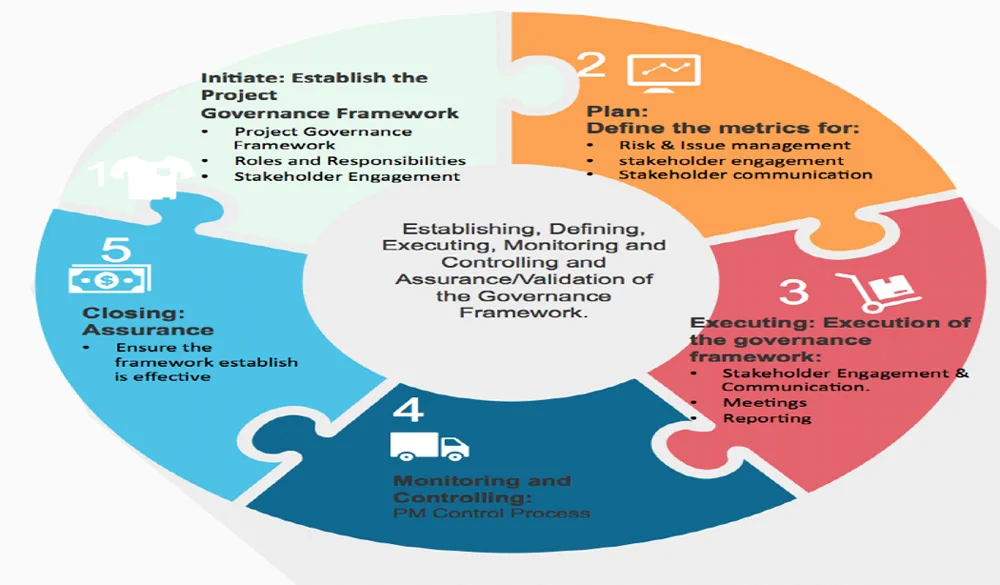
Source: PMI
Of course, each of these elements bears further scrutiny.
For example, when selecting a governance model, consider factors such as complexity and overall project prioritization. You must also define roles and levels of accountability as part of establishing a solid framework for governing project and portfolio management within the organization, as well as practices for reporting and communicating with stakeholders.
Standardization of Processes and Execution
PMO and PM practices are not one-size-fits-all. But for a single organization, it’s essential to standardize your processes to ensure consistency, both in procedures and outcomes.
As an article from PMI puts it, “There needs to be an understanding of the project’s environment to ensure that there is a right fit with the established organization’s governance.” In other words, project management must be tailored to the specific company, all while accounting for the needs of the holistic portfolio and organization. That requires standardization.
Use the same framework, PPM platform, and approaches to manage your projects and portfolios effectively.
Bear in mind that standardization does not mean that you must always choose an “either/or” methodology. For example, you might apply agile principles and waterfall approaches, thereby relying on a hybrid methodology. That does not go against the principle of consistency; it simply means that you are making modifications based on the unique needs of your project.
What must be uniform across initiatives is your process of selecting the various approaches and tools. By implementing this governance model, you will simplify your procedures and make them more objective.
Stakeholder Communications and Transparency
Transparency is one of the most important elements of an effective governance strategy. Without it, you cannot show your results clearly. This requires strong communication.
Establish communication channels for ensuring that stakeholders are involved and have the information they need.
Communication should be frequent and thorough. You should have point people for various aspects of your plans to avoid overwhelming the individuals involved. However, overcommunicating is better than undercommunicating.
Proactive Risk Management: Leading with Foresight
Which leading KPIs can PMOs use to proactively surface risks and issues before they escalate, enabling real-time mitigation? Let’s unpack this.
Why Lagging Indicators Aren’t Enough for Risk
With inadequate risk management, PPM plans are incomplete and ineffective. Lagging indicators, although an important part of PMO governance, are not enough for managing risks effectively. They focus on what has happened, rather than what can or will happen. That means that once you see a risk due to a lagging indicator, it’s too late to do anything about it.
For example, if you are looking at software failures, these issues have already taken place and may have already lost you clients.
Leading indicators are necessary for taking a proactive approach to risk management.
Implementing Leading Risk KPIs
Leading risk management KPIs can help you identify issues earlier—before they have even occurred.
For example, you could use the KPI of risk identification frequency to evaluate how frequently you’re able to spot risks before they interfere with the project progress or results.
To effectively implement leading risk KPIs, you should apply a standardized process across your portfolios. Define the tools, methodologies, and people involved in risk identification. Create a framework with clear steps to ensure they are documented and mitigated appropriately.
Key Leading KPI: % of Projects with Updated Risk Registers
A risk register is a tool for pinpointing potential risks that could affect your project. In it, you list any risk you can think of that might interfere and impact your goals. You should also state what team members are actively doing to mitigate these risks and regularly update the document throughout the course of the project.
When evaluating the percentage of projects with updated risk registers, measure the proportion of your projects that have risk registers regularly assessed and updated within a previously established timeframe.
A key leading KPI, this metric evaluates your team’s ability and efforts to identify risks and rectify them before they negatively impact your project.
Strategy: Proactively Surfacing Risks with Automated Alerts
Prism PPM has a dashboard exclusively dedicated to risks that you can access to stay on top of threats and mitigate them before they become a problem. That way, you prevent problems from turning into crises.
You also don’t have to track these risks manually, which can be tedious and time-consuming. Plus, human beings simply don’t have the wherewithal to monitor and take action on every possible threat to your project.
AI can.
AI tools allow you to surface the most urgent threats and triage or prioritize them accordingly. The result is more accurate risk identification and faster response times.
Strengthening Governance Through Data Integration
An important principle in your arsenal of PMO governance best practices is leveraging data.
Specifically, you should focus on merging data from various sources and using advanced analytics from PMO software. This helps ensure reporting and governance consistency across your portfolios.
With a PPM platform, you can establish a centralized view of projects across your organization and portfolios, ensuring data from various sources is collected in a single, unified tool.
This creates better visibility across teams, so you can see all your data and information in one place—project statuses, resources, risks, roles, and so on. You’ll have a holistic view of all your projects and data, as will everyone who needs it.
Tying KPIs to Stage Gate Decisions
PMOs must integrate governance reviews (like stage gates) closely with data and portfolio-level KPIs to inform go/no-go decisions. KPIs provide concrete data attesting to the project’s value.
You cannot rely on gut feelings to make critical decisions about your projects. Instead, you need measurable data to justify decisions—decisions like whether to move forward with the project at each stage gate.
By leveraging KPIs, you can determine whether your project is on track and ready for the next phase.
When you’re applying the stage gate framework, ensure you define KPIs for each stage, selecting the ones that are most important and relevant to that specific phase of the project. Establish criteria for making decisions about whether to “go,” “hold,” or “kill” the project as well.
Moving Beyond Post-Mortem Analysis to Go/No-Go Decisions
This process also requires a shift from post-mortem analysis—that is, looking back at what has already taken place—to making proactive, forward-thinking decisions. This means you’re using data to inform your processes and accounting for risks upfront. You will make better-informed decisions, rather than simply reacting to what has already been completed and cannot be changed.
That doesn’t mean reflection after a project has no place. It is important to take this step or series of steps to inform future projects.
However, the “Go/No-Go” framework is superior in allowing you to understand why certain actions are necessary (or unnecessary) and is a more proactive approach.
Ensuring Portfolio-Wide Compliance
Accounting for governance and compliance issues, PPM software like Prism PPM provides robust tools equipped with features such as:
- Automated alerts
- Dashboards and reporting
- Standardized workflows to ensure consistency
- Data security
- Reportable audit detail logs
Of course, team members must also do their part to ensure portfolio-wide compliance.
The PMO should institute a transparent framework and organization-wide policies. It should also stay abreast of regulations governing data usage within and outside of the industry. Regular reviews of policies and frequent staff training are essential as well.
The Role of Audit Trails and Data Integrity
Audit trails are important in any risk management scenario. As you might imagine, they provide a paper trail of actions you have taken, both individually and collectively. This helps ensure accountability and transparency, giving concrete evidence of steps you have taken. If errors occur, you have an indisputable record of what has transpired so you can easily investigate where things went wrong and why. It’s also essential for risk prevention, allowing you to scrutinize actions that could cause problems and resolve them before they do.
Data integrity is related to audit trails—your audit trails, and everything else relevant to your portfolio, must be accurate and trustworthy. Data integrity refers to the completeness and accuracy of this information.
Leveraging a tool like Prism PPM, which provides trustworthy reports and audit logs, ensures that you can rely on your data.
Risk Mitigation Through Portfolio Control
PMO governance best practices encompass risk mitigation through careful control of your portfolios. The following steps and processes help you account for risks before they escalate and negatively impact projets—and the organization.
Managing Inter-Project Dependencies and Risk
Risks can be hidden, especially in portfolios with large numbers of interdependencies. When processes and activities must be sequential, for example, it can be difficult to identify where, precisely, a risk might occur.
Or, perhaps you’re not fully aware that certain projects require resource sharing, and there is a risk in falling short in terms of funding.
To manage project interdependencies and account for risks, you should map them out at the beginning of the undertaking. Brainstorm as many as possible, trying to account for every possible scenario. This should be done collectively as a group to ensure that you have thought of all potential risks.It can help to do this visually. Prism PPM provides a tool that allows you to map out dependencies and interdependencies.
Then, classify and assess the relative impact or importance of each risk. From there, you can establish a plan for mitigating the risk. Ensure you continue to monitor these threats so you can address them in a timely manner.
Using Scenario Planning for Risk Exposure Modeling
Scenario planning is another helpful way to surface risks. Through this process, you come up with hypothetical scenarios and assess the possible outcomes and risks the scenarios might pose.
For example, you might posit, “What will happen if X team member is out sick for a week? How will that impact the project?”
Then, you should brainstorm the possible effects, before developing strategies to deal with various outcomes.
Technology can aid scenario planning and risk modeling. Prism PPM’s “What If” feature allows you to analyze a range of scenarios to help you predict and analyze various risky situations.
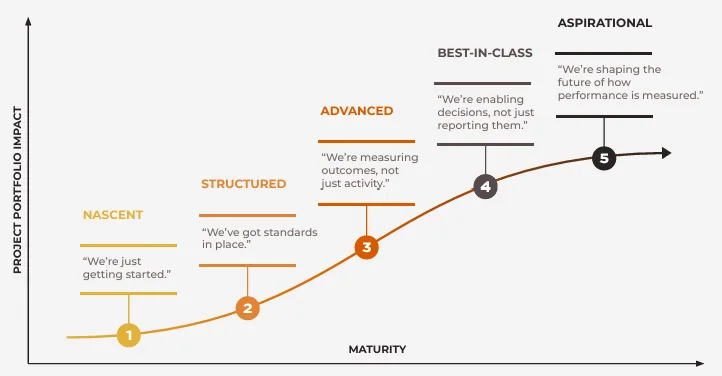
Achieving Maturity: Governance in a Best-in-Class PMO
A high-performing and mature PMO achieves higher project success rates, delivers projects more efficiently, and fully aligns every initiative with organizational goals. To achieve PMO maturity and strategic alignment for every project, you must take several proactive measures in order to meet the ever-changing market and stakeholder expectations.
Institutionalizing a Culture of Accountability and Transparency
“Oftentimes, it’s difficult for people to put the project and overall goals ahead of their individual objectives,” said Steven Lang, PMP, former senior program director at Project Management Leadership Group.
While there are important roles and responsibilities for every project, as well as central points of accountability, these principles must also be embedded throughout the organization. That requires a mindset shift and carefully defined processes.
To start, ensure your mission statement clearly reflects your organization’s goals. This sets the stage for commitment from every team member. You should also ensure that all team members and stakeholders understand their own roles, as well as the larger priorities of the organization.
There must be standards applied throughout the company, too. For example, provide a framework for making decisions that every employee adheres to.
Finally, it is important to create an environment where everyone feels safe taking risks and speaking up. This fosters greater independence, as well as greater accountability and transparency.
Benchmarking and Continuous Process Improvement
As you probably already know, no process is perfect, and no environment is static. One of the most essential PMO governance best practices to keep in mind is continuous process improvement.
Establish benchmarks for identifying and evaluating areas of improvement. These metrics should allow you to compare real performance against the ideal.
In creating benchmarks and measuring performance against them, you are instituting an objective (or at least less subjective) means of assessing performance, pinpointing gaps, and informing future processes and projects.
Benchmarking relates to continuous process improvement (CPI). CPI is an approach for committing to constant improvement, recognizing that factors both within and outside your control will affect your projects.
In addition to benchmarking, conduct retrospectives to reflect on performance and areas of improvement. Document everything so you can use this information effectively.
Conclusion: Implementing PMO Governance Best Practices and Risk Management
Proper PMO governance is the backbone of successful project portfolio management and risk mitigation. Gone are the days of simply checking off a list to evaluate project performance. And no longer is the PMO merely a bureaucratic and administrative enterprise.
Today’s PMO ensures strategic alignment and is integral to carrying out the goals of the entire organization.
Prism PPM helps you achieve your objectives and build stronger governance within your organization. Using this platform, you can mature as a PMO and ensure consistent and reliable project delivery.
Want to find out how Prism PPM can work for your organization? Book a 15-minute consult or a 45-minute demo.