
Key Takeaways
Modern PMOs are failing because they are using “glorified to-do lists” (CWM) to solve complex enterprise problems. To survive the “strategy fight” of 2026, PMOs must shift from tracking activities to measuring outcomes such as ROI and strategic alignment.
- The Evolution: PMOs must move from “passive reporters” to “active strategic partners” by adopting tools that offer predictive, leading KPIs.
- The Problem: Organizations waste $97 million for every $1 billion invested because projects aren’t aligned with strategy.
- The Tool Trap: CWM tools solve for communication; PPM tools solve for capacity, financial management, and risk.
Why PM Tools Fail the Modern PMO
While some project management offices (PMOs) excel at operational execution—that is, meeting deadlines and controlling budgets—they are being sidelined from the high-level decisions that drive enterprise value. And rudimentary project management tools are holding them back.
Leading PMOs overwhelmingly use new technology to deliver business value, according to the Project Management Institute. In the age of agentic AI, you must embrace data-driven forecasting to enable strategic insight and avoid becoming obsolete. The best PM tools for PMOs bridge the gap between tasks and execution.
Why Collaborative Workflow Management Tools Fall Short
Collaborative workflow management (CWM) tools like Monday.com and Smartsheet are sufficient for task tracking but insufficient for the “strategy fight.” They can’t handle complex portfolios and functions. For example, Monday and Smartsheet have reporting limitations for enterprise-level PPM.
Instead of disconnected and siloed data repositories, you need a single source of truth. Ultimately, if you rely heavily on these limited tools, your team members will spend more time trying to find information and workarounds than carrying out their responsibilities.
CWM Limitations
While CWM tools offer some benefits to smaller organizations with few projects at a given time, those undertaking larger and unconnected initiatives will find them lacking. Here’s why.
Lack of Strategic Portfolio Management Capabilities
Collaborative workflow management tools don’t provide comprehensive strategic portfolio management capabilities. Instead, they only offer a limited view of tasks and discrete projects. It is difficult to see interdependencies and understand how projects tie to overarching, enterprise-wide goals. It is also tricky to prioritize and understand which projects will deliver the most value.
Minimal Features
While CWM tools offer some PPM features, they tend to be minimal. To manage project portfolios, you need a high-level view of resource allocation, capacity planning, performance and predictive analytics, risk management, and more. Reporting features are typically basic, without necessary customizations and multiple views.
Tactical vs. Strategic
Tools like Monday.com and Smartsheet are geared more toward project management than portfolio management, meaning many companies will outgrow them as they build their efforts. Project management tools focus on day-to-day activities, often adhering to the “iron triangle” approach of ensuring projects are delivered on time, within scope, and within budget.
PPM is a strategic approach to managing initiatives and requires a platform that allows you to see whether you’re working on the right projects, all toward the goal of meeting your organizational goals.
Insufficient Scalability
As your PMO and entire organization grow, CWM tools will prove limited. Interfaces and repositories become overly cluttered. It is difficult to find the information you need, and the tool becomes burdensome, rather than aiding productivity and efficiency.
The Rise of Agentic AI and Modern Technologies in PM Tools for PMOs: Features All Platforms Should Have
What are the technical and strategic differences between task-trackers like CWMs and portfolio-optimized solutions (PPMs)? Why are the features that CWMs have insufficient for holistic PPM? Let’s take a closer look.
Artificial Intelligence and Agentic AI
The rise of agentic AI in 2026 changes the definition of a “valuable” PMO leader. A late 2025 McKinsey report finds that 88% of organizations use AI regularly for at least one business function, up from 78% in 2024. The technology is proving critical for spearheading or driving PMO digital transformation.
AI helps with routine task automation, resource capacity planning and allocation, forecasting, and much more. Predictive analytics allow you to assess risk and make decisions fast.
Modern PPM platforms like Prism PPM incorporate AI to streamline workflows and save you time.
Dashboards and Data Analytics
Dashboards and data analytics give you a big-picture view of your project portfolios. Manual reporting is time-consuming and error-prone. PPM platforms perform automatic reporting, giving you real-time insights to inform your plans and make smarter decisions.
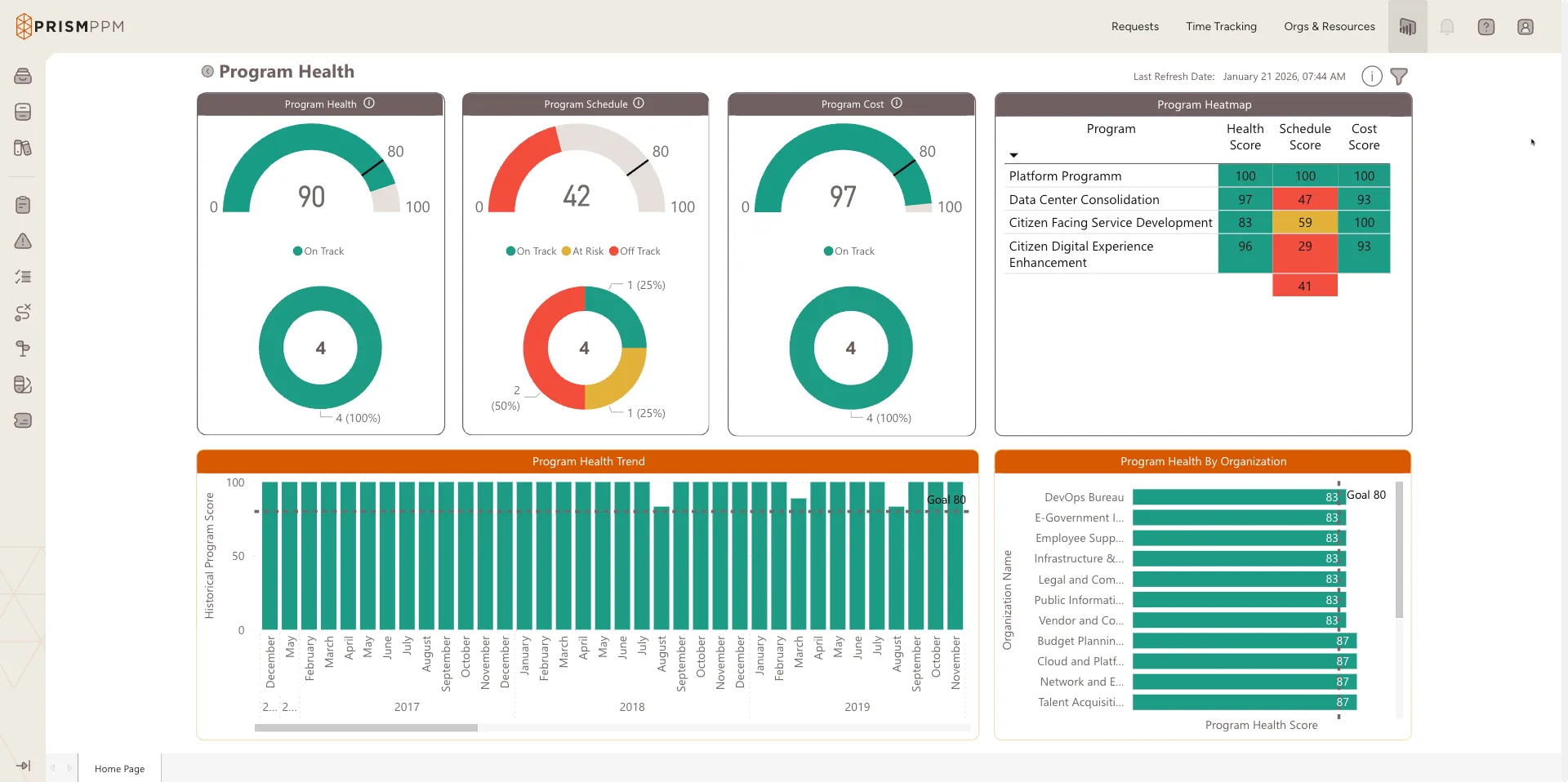
Prism PPM program health dashboard.
These tools also provide a centralized view of your projects so you can see where initiatives stand at a given time and prioritize effectively. You won’t have to worry about pulling data from various sources because it’s all in one platform. This enables better collaboration and visibility and leads to better project outcomes. You will also improve risk management by leveraging data-driven insights to make more accurate decisions.
Seamless Integrations
Legacy and overly simple project management platforms often don’t integrate with essential tools. But integrations are necessary for centralizing your information, improving communication and collaboration, ensuring smooth workflows, and establishing a single source of truth.
Modern and sophisticated PPM platforms integrate seamlessly with other core technologies, such as enterprise resource planning (ERP), communication, customer relationship management (CRM), financial management, and document management tools. That facilitates cross-departmental collaboration and allows everyone to tap into the same information. It also breaks down silos and reduces manual labor and time spent searching for the right data and systems.
Scenario Planning
When projects are interdependent and serve a common purpose, even small changes can influence outcomes. You must perform scenario planning to understand the impact of different factors. This is difficult to do manually, which is why a platform like Prism PPM is so useful. The tool is equipped with a “what-if” scenario-planning feature, allowing you to plan for future uncertainties.
Using Prism PPM, you can draft and map out various potential outcomes, simulating diverse changes and visualizing the impact of each. That helps you adapt to unforeseen circumstances, take proactive measures to curb risk, build resilience, and make more informed decisions. You will be well prepared for a wide array of scenarios and develop appropriate responses, allowing you to be flexible and competitive. You will also be able to adjust your strategy by using concrete, real-time data, thereby optimizing your resources and enhancing productivity.
Metrics for PMOs and Executives
Research shows that up to 70% of PMOs fail within their first three years. Some of the main causes include a lack of clear objectives and a failure to align with the organization’s business strategy.
An important part of project portfolio management is establishing and leveraging the right key performance indicators (KPIs)—ones that align with strategic objectives—to assess progress and ensure that you are taking on the right projects at the right time.
PPM platforms like Prism PPM allow you to track these KPIs and metrics to evaluate project statuses at any given time. That way, you can stay on top of factors like resource utilization, budgetary matters, overall performance, and individual project performance.
PM software typically assists with simple metrics, such as the iron triangle indicators. However, more thorough platforms give you far more information, which, in turn, gives you far more insights for evaluating your portfolio health.
When establishing custom metrics, consider KPIs such as:
- Strategic value realization
- Return on investment (ROI)
- Resource utilization
- Time to market
- Net promoter score
- Risk management effectiveness
- Employee satisfaction score
- Benefits realization rate
Using these and custom metrics will help you demonstrate the PMO’s value to executives and prove your “worth” as a leader.
Conclusion: Leveraging Modern PM Tools for PMOs
Why are PMOs with high operational excellence still being excluded from executive strategy sessions? Often, it’s because they are failing to prove their strategic value. It’s not that they’re not delivering—it’s that their results aren’t obvious enough to leadership.
With a comprehensive PPM platform like Prism PPM, you can demonstrate your impact and become an integral part of leadership and strategy discussions.
Strategic portfolio management is achievable with the right PM tools for PMOs. Overhaul your workflows, track metrics, replace manual processes with automatic ones, improve collaboration, and gain clarity across the enterprise.
Ready to trade status reporting for strategic insight? Book a demo to find out how Prism PPM ushers you through the PMO transformation.