
Key Takeaways
The traditional PMO is at an existential crossroads. While most excel at “delivery mechanics,” a widening gap exists between basic project execution and the strategic value executives actually demand.
- The Threat: As Agentic AI automates routine workflows (planning, resource allocation, and reporting), PMOs stuck in “business as usual” risk becoming obsolete.
- The Gap: Only 18% of project professionals demonstrate the high business acumen needed to align projects with market trends, leading to a 27% higher failure rate.
- The Pivot: By 2026, PMOs must shift from doing to leading. Survival requires evolving into customer-centric, nimble, and data-driven partners that bridge the gap between strategy and execution.
A New Era for the PMO
PMO leaders: It’s time for a wake-up call. In 2026, if you’re focusing only on delivery mechanics, you are risking your career. We are at a breaking point, where executives no longer have patience for mere process-driven reporting and procedure standardization. Something’s got to give.
Today, executives demand strategic value and project value realization from PMOs. To generate high-intent leads and facilitate PMO strategic transformation, you must challenge the status quo and pivot to a new mindset and way of doing things..
Strategic Project Management and the End of the Iron Triangle
In 2026, the so-called iron triangle is no longer enough to satisfy C-suite expectations. For one, modern projects are far less predictable than those of yesterday. Time, cost, and scope are important factors, but they are not the only ones to consider. We need complex models to deal with complex challenges and cope with the unpredictability of a dynamic environment.
It’s not just about stabilizing the triangle—it’s about project value realization and holistic strategic alignment with the organization’s overarching mission and goals. We need flexible frameworks that move beyond the rigid constraints of the iron triangle.
The Cost of the Business Acumen Gap
Only 18% of project professionals demonstrate high business acumen—the ability to understand market trends and financial drivers—and that is leading to a 27% higher rate of project failures, according to PMI’s 2025 Pulse of the Profession report. Business acumen for PMOs is essential as their role changes. As you grapple with increasingly complex decisions, you must have the knowledge and skills to lead high-level initiatives.
PMOs are responsible for articulating a vision that corresponds with leadership goals. They define the criteria for project prioritization, create standards for project execution, determine KPIs and metrics for evaluation, and ultimately decide how to undertake projects that will deliver the most value at the right time. That requires far more than maintaining documentation and reporting—it demands strong business judgment and intelligence.
Organizations must innovate at scale to remain competitive. PMO leaders are integral to this purpose. They support change management by playing an integral role in choosing and spearheading projects that will help organizations persist. They are foundational to delivering value, ensuring strategic alignment and setting the direction to create the most impact.
PMO Strategic Transformation: Driving Forces
The project management office is morphing into a value-driven enterprise. What is shaping the newly defined PMO? Here is a look at the factors influencing this dramatic shift.
Digital Transformation
Organizations of all shapes and sizes in practically all industries and niches must digitize to stay current. Digital transformation is central to the PMO’s transformation from compliance and admin center to strategic partner.
PMOs must harness technologies like artificial intelligence/machine learning and predictive analytics to make more influential decisions. Platforms like Prism PPM help you achieve digital transformation, taking you from a nascent to a mature enterprise.
Agile Frameworks
The modern PMO demands flexibility. It must pivot quickly as circumstances change—which they do frequently on occasion. Adopting agile or hybrid frameworks is key to achieving this flexibility.
Through these approaches, you will accelerate growth, achieve innovation, improve performance, and adapt more effectively to unpredictable circumstances. By adopting agile frameworks, you become a more strategically aligned office.
KPIs and Metrics
It is no longer just about the number of tasks you’ve completed on time and within budget. Instead, you must shift to value-focused KPIs and metrics.
Evaluate your projects and portfolios according to metrics like benefits realization, stakeholder engagement, return on investment, resource utilization, and strategic alignment.
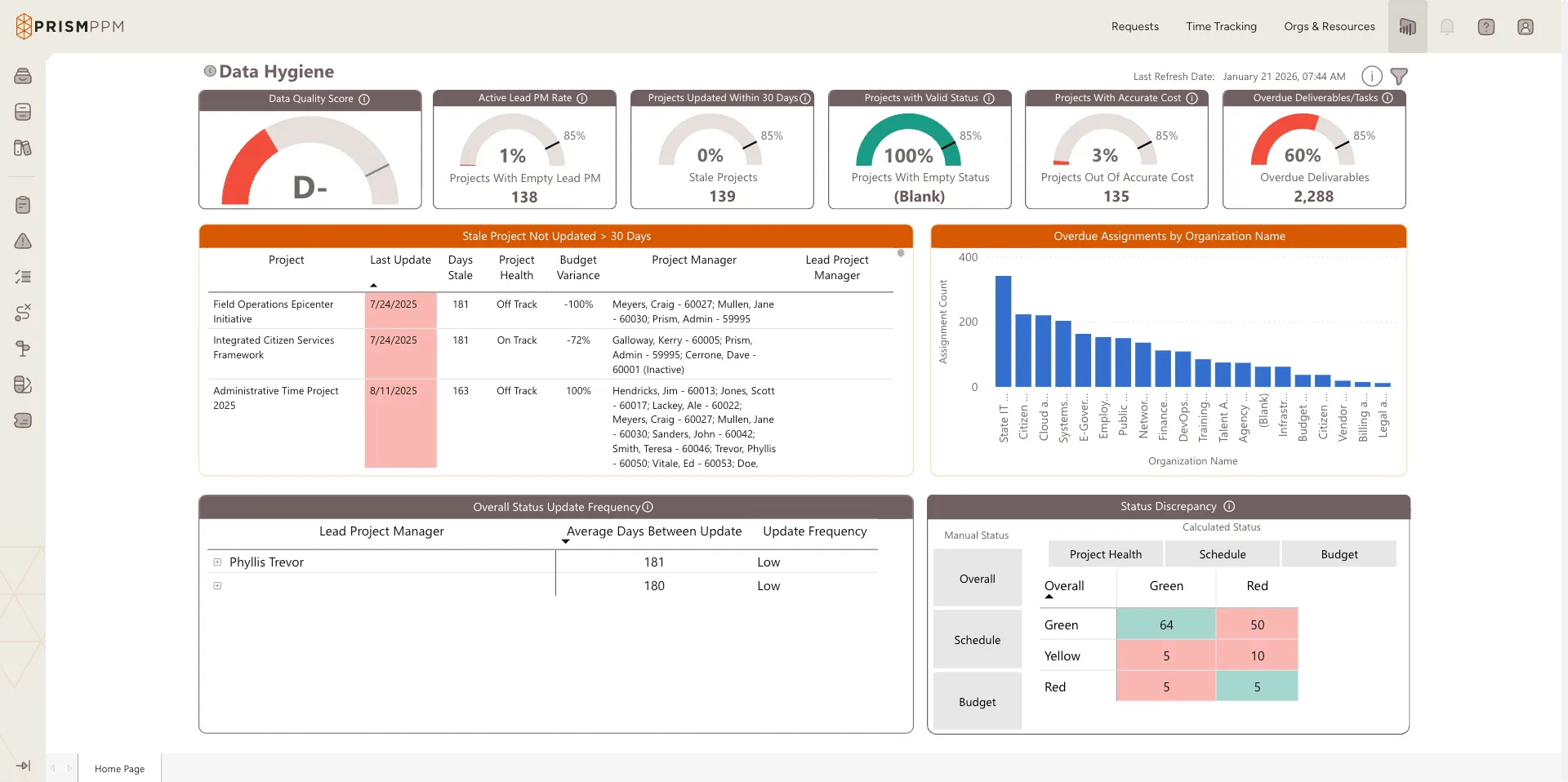
Agentic AI and PMO Strategic Transformation
How is agentic AI automating the “doing” of project management, and what does that leave for the PMO leader? How do you take on your new role without allowing AI to take over?
It is impossible to ignore the role of agentic AI in project management. We’ve all heard about the pros and cons of this seemingly impenetrable force. There is no doubt achieving PMO strategic transformation requires you to tap into AI to gain efficiency and attain invaluable, data-driven insights.
But will it replace PMO leaders?
With 74% of organizations planning to leverage agentic AI within two years, PMO leaders are naturally wondering: What role will we play?
With the right tools, humans still have an important role in the PMO.
The best project portfolio management (PPM) platforms allow PMOs to reduce the time spent on manual, administrative tasks and increase the time spent on strategic decision-making. For example, Prism PPM handles critical functions like reporting, resource allocation, predictive risk management, and what-if scenario planning. It offers real-time insights to allow you to adjust your strategy.
But none of this can happen without humans spearheading your efforts.
That said, your role will evolve. You must understand that you can no longer be reactionary. You are continuing to lead people and projects, but you’re also leading AI. Right now, agentic AI still needs humans to guide it.
For example, you must feed your systems proper data to get correct outputs. You must be cognizant of factors like bias and security, ensuring your inputs are high-quality and accurate and reflect the complete picture. You also need to establish frameworks for partnering with agentic AI, testing your tools before deploying them across your company.
That said, PMO leaders will be required to upskill in order to work with AI agents. They will be responsible for prompting, overseeing their efforts, evaluating their results, exercising good judgment, and otherwise governing the systems.
PMO leaders must also assume the responsibilities agentic AI can’t handle. For example, however powerful artificial intelligence is, it can’t ensure strategic alignment. It can’t contextualize your strategy and goals in the overall organization and its history. And it can’t make high-level decisions.
PMO leaders can.
They should view agentic AI as a partner in their efforts. Agentic AI, for now, will handle routine tasks and inform PMOs. Humans will leverage AI’s work to inform their efforts and innovate.
Bridging the Gap Between Strategy and Execution
Strategy alone is not enough for strategic alignment. You must bridge the gap between strategy and execution.
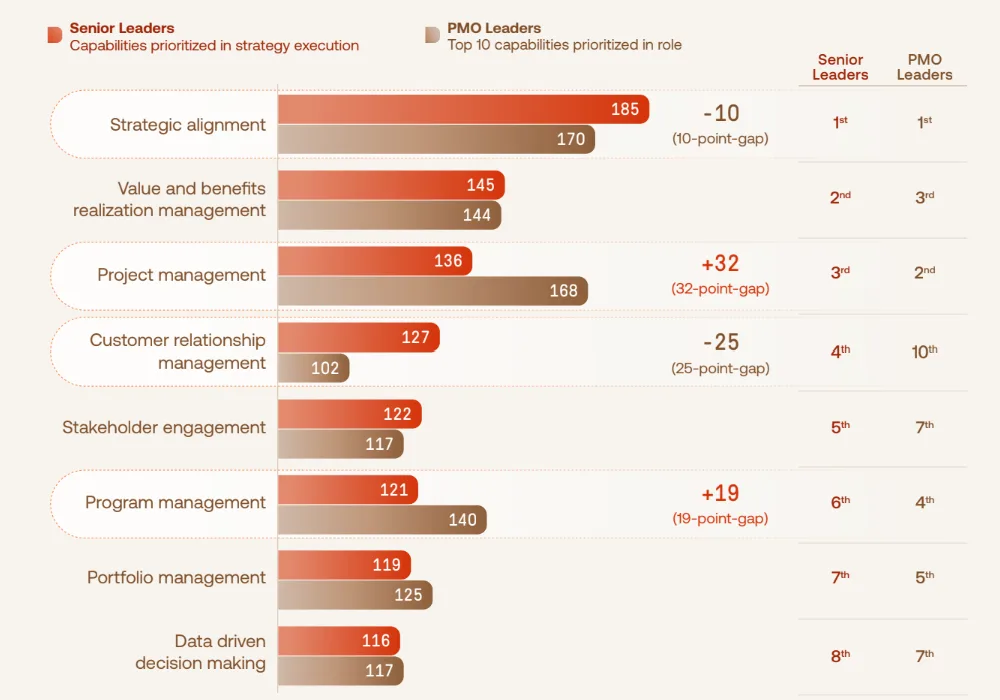
Image Source: PMI
So, how do you bridge that gap?
That is your most important role as a modern PMO: connecting strategy with operations and action. This, of course, starts with executive alignment.
You need to understand leadership goals and expectations. You must encourage leadership to view you as a partner in driving results, not an administrator alone. That requires a complete comprehension of what the organization is trying to achieve today, tomorrow, and well into the future.
The strategic PMO:
- Actively engages with leadership.
- Masters various project management philosophies and approaches.
- Ties actions to results.
- Manages resources effectively.
- Leverages KPIs and metrics to measure results
- Creates actionable plans.
- Embraces agility.
- Prioritizes effectively to meet organizational goals.
- Adapts to tackle new challenges and an evolving project management landscape.
- Has strong business acumen and speaks the language of strategy.
- Ties every project to at least one strategic objective.
- Moves beyond the nascent reporting mindset to the aspirational or best-in-class mindset.
- Leverages comprehensive project portfolio management platforms to improve efficiency and elevate outcomes.
- Focuses on delivering clear value.
- Is a visionary and a leader.
Looking Ahead: The Modern PMO
The modern PMO means a dramatic shift away from business as usual. Only those leaders who embrace this reality and strategic alignment as a power that is here to stay instead of a passing trend will survive.
The PMO is forever evolving. You must be data-driven and leverage agentic AI to achieve efficiency and productivity, gain meaningful insights, predict outcomes, sustain growth, and generate value.
PMO strategic transformation is central to the office’s new role. It represents a cultural shift and structural change.
How, then, do you deliver greater business value while supporting change and leading your organization toward real results? You need the best technology in your corner.
Prism PPM bridges the gap between strategy and execution, helping you deliver a meaningful ROI. More than simply a tool, it is an essential partner for PMOs to transition from the bearer of bureaucratic red tape to a strategic value driver.
Want to find out how? Book a 15-minute consult or a 45-minute demo.