
By Caitlin Bowen & Kris Sprague
Key Takeaways:
- Customer-Centric Shift: True PMO value is defined by the customer (executives, teams, and partners). Success requires building genuine partnerships rather than just enforcing abstract processes.
- The Value Ring Dimensions: The framework measures impact across three pillars: Service Monitoring (efficiency), Value Delivery (impact), and Value Recognition (stakeholder acknowledgement).
- Strategic Foundational Elements: A successful PMO mandate is built on organizational strategy, governance, and a culture of performance maturity.
- The PMO Flywheel: Operationalizing value is a continuous 10-step cycle—from awareness and needs assessment to service development and measurable benefits realization.
Introduction
In February 2025, the Project Management Institute (PMI) released its groundbreaking Project Management Offices: A Practice Guide, a comprehensive resource developed through global collaboration among PMO professionals. The guide is designed to support PMOs at every stage of maturity, empowering them to evolve into strategic enablers that deliver measurable value across diverse organizational contexts.
As a member of the PMI PMO Practice Guide Development/Reviewing Committee, Kris Sprague had the privilege of contributing to this transformative publication. We spoke with Kris to get his perspective on the importance of the PMO Practice Guide. This article draws upon several of our discussions from last year and takes a forward-looking perspective to explore the evolving requirements for successful PMOs. By reflecting on past experiences and anticipating future trends, it highlights the essential actions PMOs must take to consistently deliver value and remain strategic partners within their organizations.
Why is the PMI PMO Practice Guide so Important?
As Kris explains, “This guide marks a significant milestone in the evolution of Project Management Offices (PMOs), offering a practical and forward-looking framework for designing, operating, and continuously improving PMOs in alignment with organizational strategy.”
And research proves the importance of this approach to alignment. The 2025 “State of the PMO Research Report” found that Enterprise PMOs that link the implementation of organizational strategy with portfolio-level investments are far more likely to be high performers than other types of PMOs.
In addition, PMI’s latest Thought Leadership report titled “Bridging the Gap Positioning PMOs as Indispensable Partners in Strategy Execution” highlights the urgent need for PMOs to transform from operational executors to strategic partners, capable of driving organizational agility and delivering business value in an era marked by technological disruption and shifting market demands.
Introducing the PMO Value Ring™ Framework: A Paradigm Shift
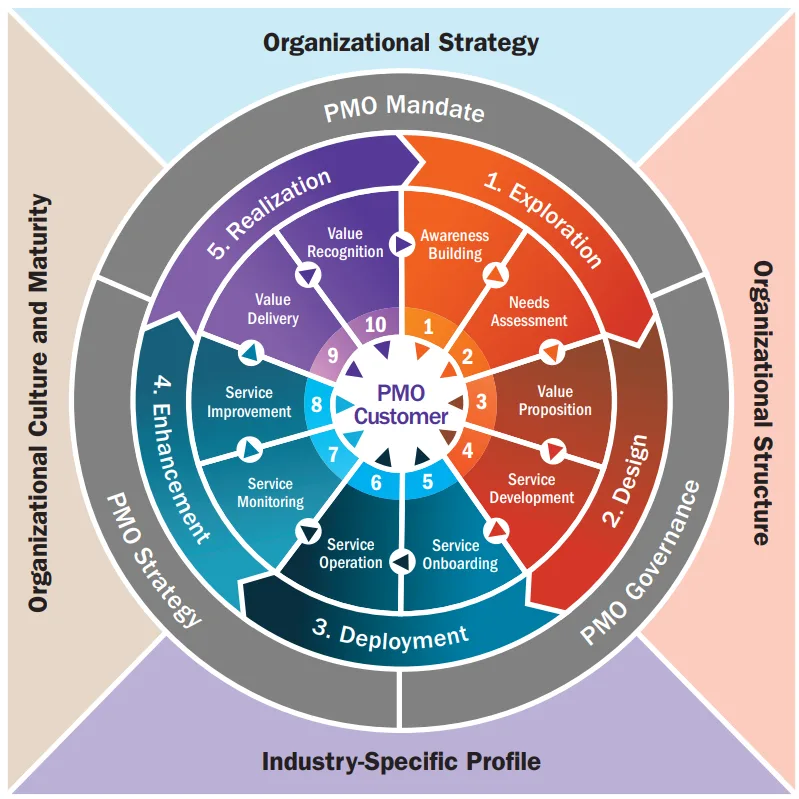
At the heart of the ongoing PMO transformation is the PMO Value Ring™ Framework. This model redefines how PMO’s role, positioning as a strategic partner that creates, delivers, and demonstrates value across three interconnected dimensions:
- Service Monitoring: Provides real-time insights into PMO service effectiveness and efficiency, focusing on tangible outputs and performance metrics.
- Value Delivery: Aligns PMO activities with customer-defined value, measuring success by customer satisfaction and impact, not just adherence to process.
- Value Recognition: Ensures that PMO contributions are acknowledged by stakeholders, reinforcing alignment with organizational goals and expectations.
This holistic approach enables PMOs to assess their impact, communicate their value, and adapt to evolving business needs.
Building a Customer-Centric PMO
“The VALUE RING positions the PMO as a service provider. After all, we’re looking at a customer-centric PMO, where C-suite leadership and executives, functional managers and teams, portfolio, program, and project managers, project team members, and external partners or clients receive the services.” Kris Sprague
A customer-centric mindset is essential for PMOs seeking to transition from process-oriented entities to strategic value drivers. PMO customers—internal stakeholders who receive, use, or benefit from PMO services—must be at the center of PMO design and operations.
Kris’ take on this is clear “Ultimately, true value is delivered through customers, not abstract business connections. Success comes from building genuine partnerships with individuals…understanding their challenges, supporting their goals, and helping them thrive. This human connection is the essential foundation for creating sustainable impact”.
Customer-centricity isn’t a philosophy; for the modern PMO it’s an operational necessity.
Foundational Elements of Project Management Offices and Structural Components
Successful PMOs are built on foundational organizational elements:
- Organizational Strategy: Guides PMO alignment with business objectives.
- Organizational Structure: Influences the PMO’s positioning and authority.
- Organizational Culture and Maturity: Shapes the PMO’s approach and stakeholder engagement.
Industry-Specific Profile: Tailors PMO practices to sector-specific needs.
Within the PMO Value Ring™ Framework three structural components are essential:
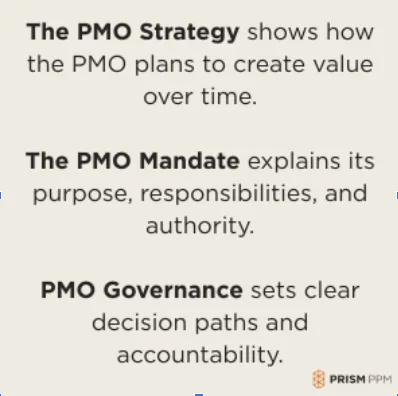
- PMO Mandate: Defines the purpose, responsibilities, and authority of the PMO.
- PMO Governance: Establishes decision-making processes, roles, and accountability, ensuring clarity and consistency.
PMO Strategy: Outlines how the PMO will deliver value over time.
PMO Mandate: The PMO Mandate serves as the guiding framework for aligning the PMO’s strategy with enterprise objectives, ensuring clarity, consistency, and measurable value delivery. One significant factor defining the PMO Mandate is the PMO coverage scope, which determines how far-reaching or influential a PMO can be. Typically, there are three levels a PMO will exist at:
- Enterprise PMO
- Departmental/Divisional PMO
- Program/Project Specific PMO
PMO Governance: Effective PMO operations hinge on robust governance, which is crucial for ensuring that the PMO functions smoothly. When PMO governance is designed well and evolved properly, the PMO adds significant value to the organization.
PMO Governance encompasses decision-making processes, levels of autonomy, roles and responsibilities, accountability measures, and the overall governance framework within which the PMO works. This framework ensures that the PMO not only operates with authority and clarity but also delivers a cohesive and reliable customer experience.
PMO Strategy: The PMO Strategy is a comprehensive and dynamic plan that outlines how the PMO will deliver value to its stakeholders over the short, medium, and long term. This strategy is a crucial element that bridges the gap between the PMO mandate and its day-to-day operations, ensuring that the PMO remains aligned with organizational goals while consistently meeting the evolving needs of PMO customers.
PMO Customer Experience Cycle
To embed customer-centricity into PMO operations, the PMO Customer Experience Cycle offers a five-stage model:
| Stage | Focus |
|---|---|
| Exploration | Understand customer needs and organizational context. |
| Design | Translate insights into strategic service offerings. |
| Deployment | Implement services and shape stakeholder perceptions. |
| Enhancement | Continuously refine services to maintain relevance and impact. |
| Realization | Demonstrate and communicate the PMO’s value through evidence. |
This cycle fosters ongoing dialogue with stakeholders and ensures that PMO services remain responsive to organizational priorities.
The Value-Generating PMO Flywheel
Operationalizing the customer experience cycle, the Value-Generating PMO Flywheel breaks down the process into ten actionable steps, from awareness building and needs assessment to value delivery and recognition. This continuous improvement mindset enables PMOs to evolve dynamically and maintain strategic relevance
| Steps | Description |
| Awareness Building | Educate stakeholders on PMO capabilities and value. |
| Needs Assessment | Identify and evaluate customer requirements. |
| Value Proposition | Articulate how PMO services address needs and add value. |
| Service Development | Design and refine services to meet strategic goals. |
| Service Onboarding | Introduce services to users and ensure adoption. |
| Service Operation | Execute services to deliver consistent value. |
| Service Monitoring | Track and evaluate service performance. |
| Service Improvement | Enhance service maturity and effectiveness. |
| Value Delivery | Realize and demonstrate tangible organizational benefits. |
| Value Recognition | Ensure stakeholders acknowledge and appreciate PMO contributions. |
Conclusion
The PMI PMO Practice Guide and the PMO Value Ring™ Framework represent a significant advancement in PMO thought leadership. By embracing a customer-centric approach and leveraging structured models like the Customer Experience Cycle and Value-Generating Flywheel, PMOs can transcend traditional roles and become indispensable drivers of organizational value.
The future of PMOs lies not in managing projects but in managing value – adapting, innovating, and aligning with stakeholder needs to ensure lasting success.
Special Thanks
Thanks to all the collaborators who worked on the PMI PMO Practice Guide and the PMO Value Ring™ Framework, including Kris Sprague, who graciously collaborated with us on this piece.
——————————————————————————————–
References:
Project Management Institute. (2025). Project Management Offices: A Practice Guide. Project Management Institute.
PMI Thought Leadership. (2025). Bridging the Gap: Positioning PMOs as Indispensable Partners in Strategy Execution. [Report]. Project Management Institute. https://www.pmi.org
PM Solutions (2025). The 2025 State of the Project Management Office (PMO). [Report]. https://www.pmsolutions.com