
Summary: Artificial intelligence transforms PPM into a proactive, data-driven strategy. The best AI in project portfolio management drives ROI by enabling intelligent project prioritization, predictive risk management, efficient resource allocation, executive reporting, and automated compliance. Treat AI as a partner to human judgment to mitigate risks like data bias and ensure data quality.
What’s chief among the 2026 PPM trends? Artificial intelligence. AI is no longer a “plugin” for PPM; it is the engine for adaptive portfolio management, allowing leaders to move from reactive tracking to proactive, data-driven strategy.
According to Harvard Business Review, 80% of project management tasks will be run by AI by 2030. But it’s not a catch-all for every task or initiative.
What are the best AI in project portfolio management use cases? How do you think beyond the conceptual idea of AI to actually create meaningful change in your PMO? How do you overcome risks and challenges associated with agentic AI in project management?
From predictive risk analytics to intelligent portfolio optimization, discover how AI is driving ROI and aiding the PMO in 2026.
5 Best AI in Project Portfolio Management Uses
Project managers who leverage AI observe myriad benefits, ranging from enhanced creativity to better collaboration and productivity, research shows. Here, we will look at the best AI in project portfolio management use cases.
Project Prioritization
Too often, leaders fail to consider the entirety of the organization’s initiatives and how they contribute to strategic goals. Rather than focusing on discrete projects, AI agents analyze vast quantities of data across the enterprise and offer insights into which ones deliver the most value and are the most likely to succeed.
AI transforms project prioritization, central to PPM, from a painstaking manual procedure to an automated and data-driven process. That leads to intelligent portfolio optimization, ensuring that your projects are dynamically prioritized and reprioritized without human bias.
That said, project prioritization demands executive and stakeholder input, something AI can’t accomplish independently.
The Prism PPM approach: Prism PPM creates a project request form customized to “score” projects according to organizational priorities. Agentic AI quickly learns how to answer key questions such as:
- Which project is more important to company goals?
- What’s the health of my projects from most to least important?
Risk Management
Through predictive analytics for project risk, AI tools surface potential problems, such as budget overruns or project delays, before they occur. That allows you to manage risks proactively. You can then adjust timelines, resource allocation, and more, ultimately preventing disaster before disaster strikes
How does this happen? AI agents monitor data in real-time, quickly evaluating it and noting patterns that are undetectable by the human eye. They flag potential issues, sending warnings and alerts. That informs your overall strategy and ability to prevent issues from escalating or occurring at all automatically.
The Prism PPM approach: The platform uses already-existing data to inform decisions. It has built-in risk registries that surface the data your project managers are seeing firsthand. It also continues to track the completeness of these registries through “data hygiene” reports, telling you what’s missing. You’ll be rest assured that you’re working off of a complete data set.
Resource Management
AI resource allocation software allows you to identify the staff, tools, time, and other resources needed to complete your project successfully. The system can even forecast the blend of resources you will need proactively and adjust allocation as your needs change. It will analyze previous project data to determine how to expend resources most efficiently.
For example, AI agents can predict potential shortages or delays before they become serious issues. That allows you to adjust your resource management strategy to prevent these problems from occurring.
These tools can also automatically address allocation as the project progresses. For example, they may recognize that a team member has too many tasks on their plate and will reallocate responsibilities to another team member who can handle more tasks at a given moment.
But if you lack vast amounts of data to inform these patterns, you must spend considerable time “upskilling” AI tools.
The Prism PPM approach: AI scales Prism PPM’s “What-If” scenario planning tool. You can ask AI agents for insights into upcoming staffing bottlenecks, get a complete analysis, and run the hypotheticals through the platform to evaluate accuracy and impact across the portfolio.
Aggregating Reporting
Natural language processing (NLP) digital agents are pros at status reporting. They summarize reports from hundreds of projects and aggregate them into a single executive-level insight dashboard.
However, while these reports are buildable, they require time to update and feed real-time project data. It also takes significant effort to create new graphics and widgets as your measurement needs matures.
The Prism PPM approach: Prism PPM provides comprehensive dashboards that surface key PPM metrics like project health and portfolio status, a complete data dictionary, a BI gateway to scale your reporting, and an AI chat to help you derive insights from your data. This deepens your understanding of root causes and risk, so you’re not expending valuable time building dashboards.
Automated Governance and Compliance
Manual audits are tedious and time-consuming. Agentic AI helps ensure that every project in your portfolio meets ESG (Environmental, Social, and Governance) and regulatory standards without manual audits.
Where it falls short is in incorporating the human element of project management. You need to understand exactly how agentic AI is driving efficiency and confirming compliance.
The Prism PPM approach: Process improvement is essential for tackling compliance issues and staying ahead of new problems. This is faster—and ultimately better—in a tool designed to include feedback loops, continual AI learning, and a way of measuring areas that have improved over time, rather than mere deficiencies.
The Limitations of Using AI for PPM
AI is a powerful force in project and portfolio management, but it’s not infallible. Let’s look at some of its limitations and how to mitigate them.
“Garbage in, Garbage out”
A Salesforce survey finds that only 40% of business leaders believe their company’s data is reliable.
The “garbage in, garbage out” (GIGO) philosophy in project management refers to the idea that informing initiatives with low-quality data will only amplify errors, rather than correct them. Data is the backbone of AI, so if the data you have is unsound, the decisions AI agents make with it will be flawed as well. This leads to inaccuracies across the board, from budgetary problems to incorrect reports.
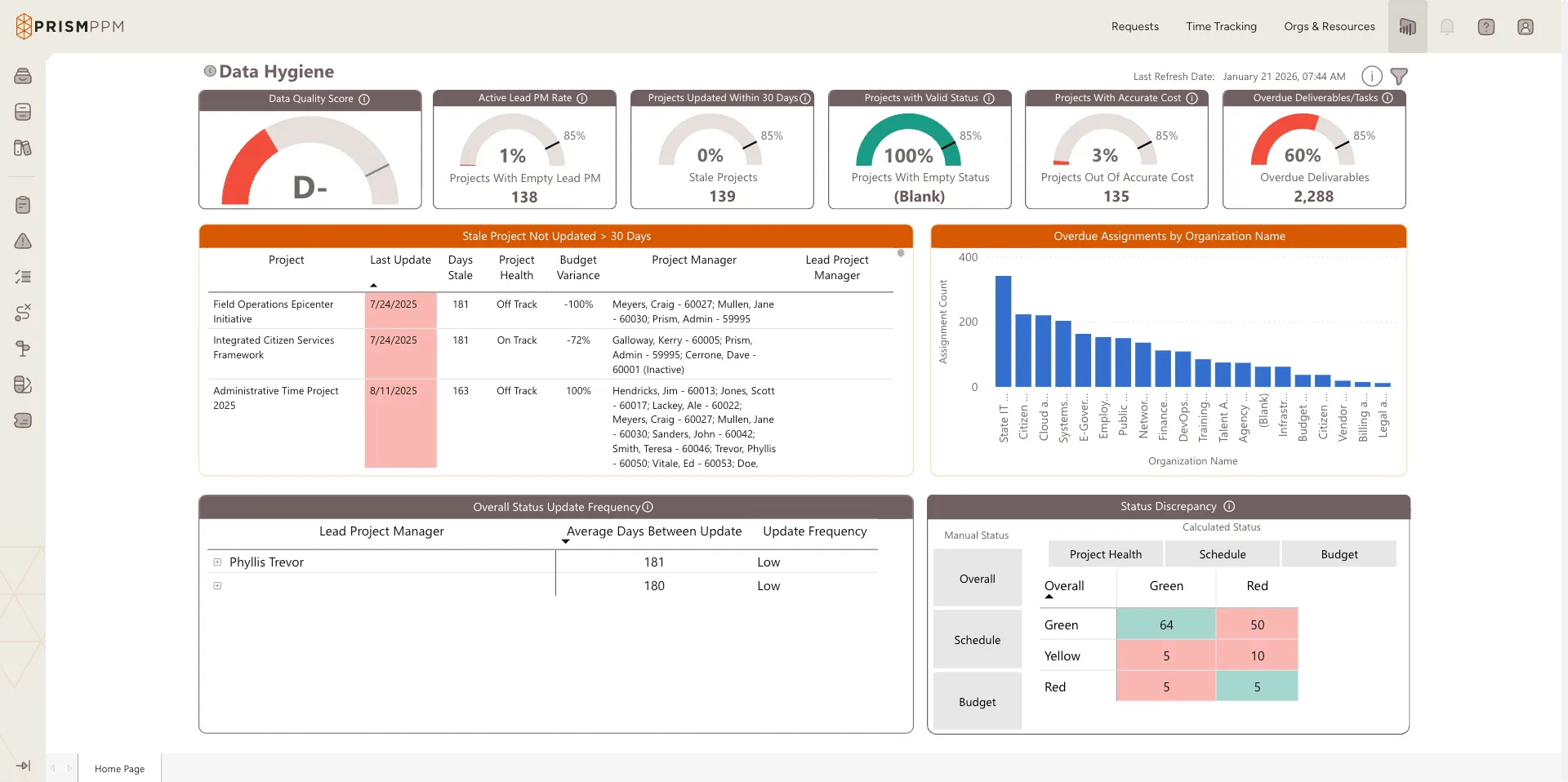
The data you use must be standardized and verifiable. That requires a rigorous data governance policy, with cleaning, validation, and continuous monitoring. In Prism PPM, embedded reports like the Data Hygiene dashboard keeps teams honest about data governance, flagging missing or seemingly inaccurate data.
No Context or Nuance
AI can analyze complex data, recognizing patterns and drawing conclusions. However, it lacks context and nuance.
While it may be able to understand the specifics of a given project or even entire portfolio, it won’t necessarily be able to contextualize the initiative in the larger history, strategy, or culture of your organization.
If you rely solely on AI to make critical decisions, you could end up amplifying errors and introducing greater inefficiencies. Instead, you should treat AI as a partner in your efforts, rather than a replacement for human thinking. As the human, your job is to contextualize the AI agent’s conclusions and make strategic decisions based on this comprehensive knowledge.
Team Resistance
Team members may be reluctant to buy into the power of AI. Perhaps they fear that it will replace them or make them redundant. Or, they’re worried that they won’t know how to use it.
When teams are resistant to AI adoption, the technology is less effective and transformative. To confront and address user skepticism, provide ample support to your staff as they navigate this new technology. Ensure they have proper training so they know how to use it correctly and responsibly.
Leverage change management strategies as well. Explain how AI agents will not do team members’ work but help them do their work more efficiently. Highlight the benefits of AI, such as how it can handle the tedious tasks many people hate like data entry and manual reporting. It is also important to establish policies about ethical use of AI in the workplace.
Bias
As we’ve discussed, AI agents can help mitigate human bias in project management and selection. However, they can also perpetuate biases that already exist in previous data. This can lead to improper project prioritization, misallocated resources, and, ultimately, poor decision-making.
What’s more, you don’t have any insight into how AI tools are making their decisions, so it is impossible to justify these decisions to stakeholders if there are any problems. That’s why you always need to use diverse data sets, encompassing different types of projects and scenarios, that fairly represents all of the initiatives you undertake with your organization.
It’s also critical to to involve human judgement in the final decision-making process. You can’t simply blindly follow AI’s advice for every crucial decision. Always review and verify results, whether they concern resources or staffing.
Another key measure is continuous monitoring. That will allow you to spot anomalies and ensure AI agents are behaving in an unbiased manner.
Lack of Accountability
For better or for worse, you can’t simply blame the concept that is AI for project or task failures. Humans are the driving force behind all your initiatives. They need to be accountable for every action, including those of AI agents.
That’s why it bears repeating: AI is a partner in your workflows and efforts. It’s not a replacement for human beings. It can’t fix faulty systems that are already in place. It can’t make you a better planner. It doesn’t have the domain knowledge human beings have.
That’s why you must build and enforce a robust data governance structure. Your team members need to govern all decisions, taking into account the information AI provides along with their own common sense.
Conclusion: A New Digital Workforce for PMOs
Agentic AI in project management is not a passing fad. Your PMO needs a strong foundation, and artificial intelligence is part of that.
There are numerous ways to apply AI to your PPM strategy and project delivery. You just need the right platform to deliver optimal results.
Prism PPM is the solution. Far more than a tool, it partners with AI and your team to improve efficiency, manage risks and resources, aid project prioritization, and optimize workflows.
Want to find out more? Book a custom demo.