
TL;DR
To prove its strategic value and evolve beyond just a project tracking function, the modern PMO must shift from measuring delivery outputs to organizational impact. This transformation is driven by five core strategic metrics for 2026:
- Benefits Realization: Measures the percentage of expected value achieved from projects, using the formula (Realized benefits / Expected benefits) * 100.
- Strategic Alignment: Ensures projects contribute directly to organizational goals.
- ROI (Return on Investment): Reveals the monetary value produced compared to project costs, which helps with prioritization and positioning the PMO as a value creator.
- Stakeholder Satisfaction: Assesses engagement and advocacy for the PMO’s decisions.
- PMO Maturity Score: Evaluates the current state of the office (e.g., Initial, Established, Optimized) to determine progress and future development needs across all dimensions.
The overall strategy emphasizes simple, SMART KPIs, continuous review, and using metrics to enable proactive executive decision-making instead of backward-looking reporting.
The Evolution of Data-Driven PMOs
According to a PMI study in which respondents were asked to rate their last project or program according to how much it “delivered value that was worth the effort and expense,” just 48% of projects are truly successful. But what if the metrics aren’t measuring what matters?
Data-driven PMOs must evolve from tracking delivery outputs to measuring organizational impact. With the PPM evolving from a project tracking function to a strategic discipline, project portfolio management KPIs and other PMO performance metrics require more attention than ever before.
Here, we will examine the top 2026 PMO metrics to track to demonstrate strategic value, enable proactive decision-making, and connect project outcomes to business performance.
What Are PMO Performance Metrics?
Have you ever grappled with these challenges or pain points?
- Too many disconnected KPIs make reporting unclear.
- PMOs can’t prove their strategic value to leadership.
- Lack of actionable data slows executive decision-making.
- You have difficulty measuring portfolio health across complex programs.
- Reporting is backward-looking instead of predictive.
Project portfolio management KPIs and strategic metrics are there to track and measure progress and success.
They give you insight into your most pivotal processes and activities, allowing you to assess your strengths and what’s holding you back more objectively. Most of all, they enable you to see how you are performing and progressing toward your goals—and strategic impact.
For PMOs, metrics play a crucial role in helping you shape the organization and proving your own value as a leader. While KPIs are not the only metrics relevant to your organization, they are essential because they are tied to specific objectives. Therefore, you can see the direct impact of your efforts.
KPI selection and tracking is an important process for meeting the holistic needs of the organization and its stakeholders.
How to Choose PMO Performance Metrics
Choosing metrics for strategic impact measurement requires careful planning and evaluation.
Assess the organization’s goals.
Review the mission and chief objectives. As you are choosing your metrics, you should always have these goals in mind, remembering to link each metric to a specific objective.
Keep stakeholders involved and informed.
Communicate with stakeholders and discuss their needs and priorities. You may not be able to address every stakeholder pain point, but you should work with leadership to ensure alignment. If there is any conflict, carefully explore the reasoning behind the various perspectives to resolve it.
Select the metrics.
Use the company goals and conversations with stakeholders as a starting point. There are different approaches to choosing the right metrics for your organization. One helpful framework is the SMART framework: Specific, Measurable, Achievable, Relevant, and Time-bound. Each metric should meet all this criteria. It must allow you to collect ample data and, of course, connect to concrete outcomes.
Keep KPIs as simple as possible to prevent stakeholders and team members from getting confused.
Continually review, adjust, and refine your PMO metrics.
This selection process is not a one-off. Keep reviewing your metrics to ensure that they continue to reflect your goals. Your strategy does not stay stagnant, and neither should your metrics. You will inevitably need to refine and adjust them as your organization evolves.
5 PMO Performance Metrics
1. Benefits Realization
Benefits realization metrics are some of the most important KPIs for PMOs. They help you assess how and whether you’re delivering the benefits your projects were expected to deliver. Are these projects bringing the anticipated value to the organization?
In order to track benefits realization rate, you will need to understand what benefits you expect your projects to deliver. Before every project, create a list of these expectations. They should be concrete so that you can easily determine whether they have been realized with a simple yes or no. Then, when a project concludes, determine how many of the benefits you achieved.
Your overall benefits realization score can be calculated according to the following formula:
(Realized benefits/Expected benefits)*100 = percentage of project that have achieved the expected benefits
This score gives you insight into the value you are creating for your organization.
2. Strategic Alignment
Strategic alignment is critical for demonstrating the PMO’s value. It means that projects are contributing to your organization’s goals, which is, after all, the very purpose of project portfolio management.
To calculate this metric, create a scoring system to evaluate an individual project’s alignment with business objectives. You should also weigh each goal based on its importance to the overall organization. Score projects based on how well they align with respective objectives, and multiple these scores by the goal weight.
A strategic alignment score helps you prioritize projects more effectively: Projects with higher scores are higher priority. This means you are better able to ensure that you are devoting the most attention and resources to the projects that will positively impact your organization.
3. ROI
Project and PMO success are not solely determined by monetary value, but it does play a role. Return on investment (ROI) reveals the monetary value produced by a given project compared with the cost of the resources you’ve invested in it. It gives you insight into whether your efforts (and holistic projects) are paying off. It also helps with prioritization.
Of course, you want to prioritize the projects that will deliver monetary value. Moreover, ROI positions the PMO as a value creator and enabler.
Calculating ROI is simple:
ROI = ([profits or monetary value of the project – project costs] / project costs) * 100
From this metric, you will have a better understanding of how your projects and portfolios are contributing to your bottom line. That doesn’t just help with measuring value—it also assists you with resource allocation and utilization.
By analyzing your ROI, you can determine which types of projects are delivering the greatest profit measured against the resources you’re investing into them.
4. Stakeholder Satisfaction
When you’re ensuring your PMO is strategically aligned and impactful, stakeholder satisfaction is paramount. You need stakeholders to be engaged with your projects and advocate for your decisions because they are the ones who ultimately have authority over the direction of your office.
While there is no established formula to measure stakeholder satisfaction, there are several ways you can measure this. For example, stakeholders can rate their satisfaction with a given project on a numerical scale, such as 1-5, via qualitative assessments like surveys or interviews. Define the variables; for example, 4 and 5 indicate “satisfied.” Then, divide the total scores of 4 or 5 by the total number of stakeholder responses. Multiple this number by 100, and that is the stakeholder satisfaction score or percentage.
With this information, you can more clearly understand whether stakeholders are satisfied and engaged with your PMO and projects.
5. PMO Maturity Score
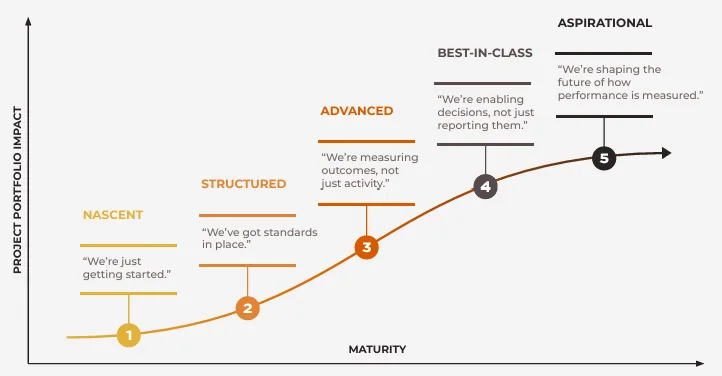
PMO maturity is important for evaluating the current state of your office and how much you need to progress.
There is no standard method of evaluating your PMO’s maturity. However, this is a general outline and standard you can follow to grade your PMO:
Nascent: Moving away from individual project tracking, although KPIs may not yet be in place.
Structured: Solidifying processes and laying the groundwork for a growing and maturing PMO.
Advanced: With well-defined KPIs in place, your strategy is more solid and data collection practices are established.
Best-In-Class: Evaluating data proactively, with a data collection system and KPIs solidly established.
Aspirational: Managing and leveraging KPIs while committed to longer-term success and making informed decisions.
Evaluating PMO maturity allows you to fully understand how your organization is performing in terms of project management. By self-assessing your PMO maturity using guidance from resources like PMI, you can determine how well your current system is working and what you need to do to level up and develop further.
Consider all dimensions of the PMO, including factors like governance and resource management. These and other factors help define the direction of your PMO and holistic organization.
Conclusion: 2026 PMO Metrics
As we move into 2026, the PMO is positioned to take on new challenges and emerge as a leader, not only in the portfolio project management space, but in the entire organization.
Proving your value and impact will be paramount and establishing yourself as an authority. In order to do this effectively, you need the right metrics on your side. You need ways to enhance their reporting and analytics capabilities to demonstrate your worth and position.
Prism PPM simplifies data visibility and impact measurement. Equipped with PMO dashboard analytics and tools for project planning, idea and demand management, strategy mapping, resource management, time tracking, and budgeting, the platform serves as a comprehensive solution for handling your metrics and illuminating your role. Book a 30-minute consult or a 60-minute demo today to find out how Prism PPM can support your PMO.