TL;DR
Project portfolio management is a standardized approach and discipline focusing on project prioritization, resource management, risk management, and value delivery that allows organizations to facilitate strategic alignment. Accounting for all projects within an organization, it ensures that you are prioritizing the projects that deliver the most value for the entire organization.
This approach differs from project management in that it focuses on holistic efforts within the enterprise rather than individual projects and their day-to-day operations.
PPM positions the PMO as a strategic ally rather than an administrative body or rules and compliance enforcer.
An Introduction to Project Portfolio Management (PPM)
“Are our projects furthering our goals?”
“Are they delivering value?”
“Do they align with our overall mission and strategy?”
These are the questions project portfolio management (PPM) answers. It’s no longer about the iron triangle, where completing projects on-time, on-budget, and within scope are the only determining factors of success. Projects must contribute to the bigger picture.
The PPM discipline was established to contextualize individual initiatives within the larger organization. Encompassing concepts like strategic alignment, project prioritization, resource management, and risk management, it’s how project management offices (PMOs) move from being compliance enforcers and administrators to strategic partners.
Project Portfolio Management: A Definition
PPM “focuses on doing the right projects at the right time by selecting and managing projects as a portfolio of investments,” according to the Project Management Institute. The approach strategically aligns projects with the organization’s goals, with the main goal of ensuring that all projects in a portfolio support the organization’s objectives, focusing on selecting and prioritizing projects that contribute the most value to the organization holistically.
Portfolios sometimes contain programs, groups of projects that are linked or related. Or, they might include projects that don’t share commonalities. In any case, every project must contribute to at least one strategic objective.
This centralized approach to managing projects together, instead of individually, is particularly ideal for organizations undertaking many important and complex projects simultaneously. Rather than merely considering day-to-day project execution, project portfolio management offers a flexible and adaptable framework for project management, reporting, decision-making, and holistic strategic alignment.
According to one study, PPM effectiveness depends on six attributes:
- Strategic alignment
- Adaptability to internal and external changes
- Expected value of the portfolio
- Project visibility
- Transparency in portfolio decision-making
- Predictability of project delivery
More specifically, PPM encompasses several key components:
- Project intake, selection, authorization, and prioritization
- Resource forecasting, balancing, and allocation based on projects that are the most comparatively important to your objectives
- Governance and monitoring
- Risk management and mitigation
- Performance and project health monitoring
The approach is also a way to avoid doing the wrong projects, including pet projects executives may be trying to push forward. Ultimately, it keeps stakeholders in the loop and positions the PMO as the project authority and decision-maker.
Project Portfolio Management vs. Project Management
Project management focuses on project execution, while project portfolio management focuses on doing the right projects at the right times. That’s the most basic distinction between the two approaches.
PM and PPM also differ in scope. PM concerns one specific project, while PPM encompasses every project in the portfolio and considers how these initiatives fit and work together.
PPM plays a strategic role, setting the direction for the organization so it can achieve its goals and prioritizing projects according to which ones deliver the most value. Project management only looks at one project, not how it fits into the bigger picture.
The approaches can and should be used together to ensure complete coverage of both meeting strategic objectives and overseeing day-to-day project execution.
| Project Management | Portfolio Management | |
| Scope | Individual project focus | Organizational-wide focus |
| Goal | Delivering project outputs | Aligning projects with strategic goals |
| Metrics of Success | Meeting deliverables | Achieving ROI and strategic value |
| Decision-Making Process | Tactical | Strategic |
| Time Horizon | Short-term, project-specific timelines | Long-term, ongoing strategic oversight |
| Responsibility | Team coordination and task execution | Project prioritization and resource distribution |
| Risk Management | Focus on individual project risks | Evaluating and mitigating risks across the entire portfolio |
| Stakeholder Involvement | Direct interaction with project stakeholders | High-level engagement with executives and decision-makers |
| Tools and Techniques | Task-specific management tools | Strategic dashboards and portfolio-level resource and risk tools |
| Flexibility | Adaptation to changes within a single project | Balancing adjustments across multiple projects to align with shifting business priorities |
Project Management Tool Categories
Different workflows require different tools. These are the main types of project management software to consider.
Collaborative Workflow Management (CWM)
Collaborative workflow management is a fairly rudimentary solution compared to the other tools on this list. Focusing on day-to-day operations, it prioritizes task management and communication. It’s limited in scope and encompasses team cohesion, collaboration, organization, productivity, efficiency, and project coordination.
Strategic Portfolio Management (SPM)
SPM platforms offer the highest-level view and bridges the gap between strategy and execution. Focusing on strategic alignment, it supports selecting initiatives that will deliver the most value for the organization and strategic alignment. The software looks at long-term goals and objectives and considers every activity, project, and initiative the organization undertakes, with the ultimate goal of maximizing value and impact.
Project Portfolio Management (PPM)
The SPM approach provides a path for PPM. A middle-ground solution, PPM software focuses on high-level goals (like SPM) while ensuring you’re delivering and executing projects (like CWM). It encompasses project selection, resource management, risk management, and much more, with the goal of doing the right projects at the right time and maximizing ROI. In a nutshell, SPM sets the objectives, and PPM determines how to meet them.
Benefits of PPM
Strategic Alignment
PPM ensures that all projects the organization undertakes align with at least one organizational goal. That means you’re aligning initiatives and objectives, thereby making certain your projects have a purpose.
This helps reduce instances of project failures and promotes cohesion within the organization. You’re doing the right projects at the right time and focusing on the highest-value projects, better equipping you to achieve your goals.
Project Prioritization
Strategic alignment and project prioritization go hand in hand. By looking at your projects holistically, you devote the most energy and resources to the projects that are most likely to pay off and generate the most value for your organization. You’re also spending fewer resources on initiatives that don’t deserve that attention, helping eliminate waste.
Resource Management and Capacity Planning
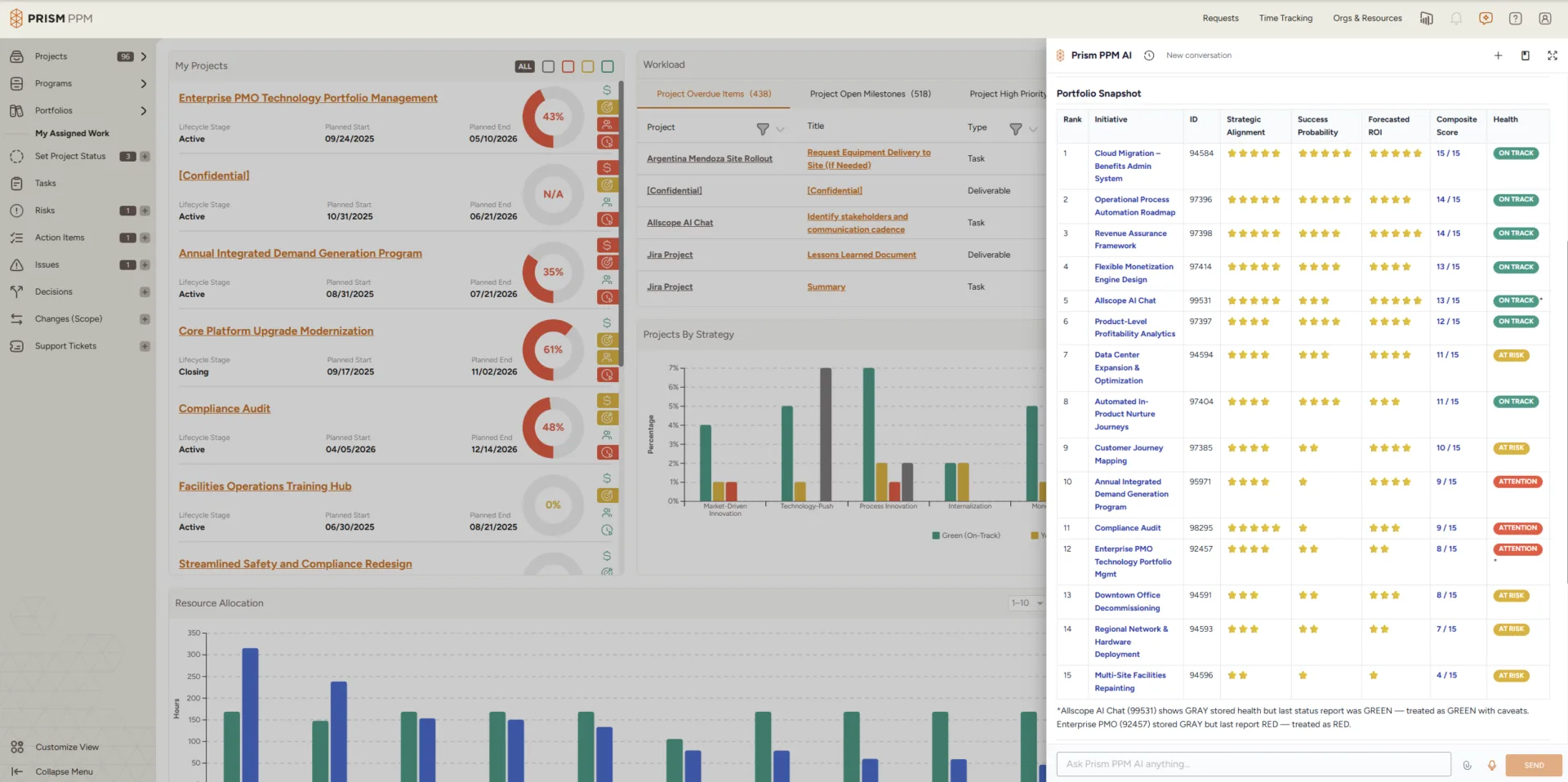
PPM gives you greater control over your resources and more insight into how to allocate them, including time, people, money, and tools. The approach equips you to forecast resource demands and improve capacity planning, understanding what you need to complete your initiatives successfully and keep them delivering value.
It also helps you achieve balance, so you’re neither under nor overutilizing resources. For example, it requires you to take into account your team’s skills so you delegate them to the most important projects while being mindful of overextending their capacity.
Risk Management
Projects always come with risk. But PPM gives you the tools to lower and manage that risk. Stakeholders have a global and holistic view of your portfolio and are better able to predict problems that might arise. Then, you can put measures in place to rectify these issues before they occur or escalate.
When you’re working with highly regulated fields like finance, healthcare, or IT, as is often the case with PPM, this is paramount because the stakes are particularly high. Mistakes can be costly, both monetarily and reputationally.
Data-Driven and Unbiased Decision-Making
The analytics and insights you derive from PPM tools mean you’ll be less biased. You’re using data to make decisions rather than the opinions of stakeholders and executives, who may have a vested interest in projects that aren’t really delivering value. You’re making data-informed decisions instead.
Reporting gives you insight into what’s working, what’s not, what has potential, and what doesn’t. While there is always a degree of subjectivity in project management, the data you gain from PPM makes the process as objective as possible.
Flexibility
Project portfolio management works with agile, waterfall, or hybrid philosophies and approaches. You have the flexibility to continue to rely on the methodology that has worked best for your organization.
PPM also allows you to respond quickly and adeptly to change and unforeseen circumstances. For example, through scenario planning, you can anticipate possible problems and know how you should best respond to a variety of circumstances.
Visibility and Transparency
A PPM platform acts as a centralized communication hub. Rather than relying on disparate systems, you have all facets of your projects in one place, eliminating silos and connecting people and processes.
The platform also gives you access to data and knowledge in real-time and enhances problem-solving. You can see how every project is performing without sifting through an overwhelming amount of information or looking at various systems. Overall, this improves visibility and creates transparency, both critical parts of project management.
Value Delivery
Ultimately, project portfolio management and its associated tools allow you to deliver greater value. Armed with these tools, you’re deriving more from your projects and portfolios, leading to benefits for your organization. You’ll communicate better as a team and with stakeholders. And you will realize superior outcomes.
Features to Look for
- Intuitive user interface
- Comprehensive and dynamic dashboards
- Visual workflows
- Scenario planning
- Performance analytics
- Roadmap planning
- Strategy mapping
- Resource optimization tools
- Risk management tools
- Scalability
- Integration with other systems
- Security
- Compliance
- Onboarding support and training
- Governance tools
Common PPM Challenges
Project portfolio management does have challenges. Let’s look at some common obstacles and how you can overcome them.
Resistance to Change
When adopting any new software, there’s the risk of encountering cultural resistance and a lack of buy-in. People are set in their ways and can be apprehensive about change. Plus, new platforms can be overwhelming.
You need a solid communication strategy to clarify the benefits of adopting PPM software. Establish a means of soliciting feedback so stakeholders and teams can share their ideas and concerns. It’s also helpful to secure a sponsor. Support from leadership goes a long way in instilling trust and confidence.
Incomplete or Inadequate Strategic Alignment
Strategic alignment is often easier said than done. When you’re in the process of adopting a PPM approach, you could discover that you’re wasting resources and money on projects that aren’t aligned with your business goals. It may be overwhelming. But it’s more overwhelming and wasteful to continue blindly undertaking projects that don’t create value for your organization.
Ensuring strategic alignment requires continual and dedicated collaboration between PMO leaders, teams, executives, and stakeholders. Everyone must understand the goals of the organization. From there, everyone must commit to only focusing on initiatives that support and further those goals. This demands thorough communication with all parties involved. There must be transparency at every level. There should also be visibility into how projects are selected and prioritized.
Overly Complex Software
Adopting overly complex software can lead to a lack of buy-in, frustration, and poor implementation. There may be some features that are overkill, especially for smaller organizations and less mature PMOs. Don’t select platforms that have more bells and whistles than your organization is ready for.You don’t want to adopt a platform with so many features that your team won’t use—that’s a waste of money and will be confusing for your team, even leading them to avoid using it.
Also avoid software that is too rigid and won’t scale as you grow and mature. Flexible software is easier to manage and configure to your organization’s needs. You should carefully assess which features are mandatory and nice to have and offer thorough onboarding and training.
Data Silos
With no single source of truth, information is spread across disconnected systems. That means team members aren’t looking at the same data, so they have an incomplete view. Executives don’t have the right information at the right time, meaning they are ill-informed about the state of the projects and how they are progressing holistically or fitting into the larger picture. This can lead to numerous hiccups: project delays, poor coordination and collaboration, resource management problems, and, ultimately, bad decision-making.
A PPM platform provides full visibility into the state of all the projects in your portfolio. It gives you that single source of truth and offers ample reporting, eliminating these data silos.
Conclusion
When you’re managing multifaceted, complex projects, project portfolio management is the best approach. You must do the right projects at the right time, and PPM helps you fulfill that mission
But PPM can be difficult to navigate. You need the right platform to help you manage the process and your projects.
Prism PPM is a high-quality solution for organizations of varying types and sizes to adopt a robust project portfolio management approach. Book a custom demo to learn more about how Prism PPM works to help you achieve your goals.